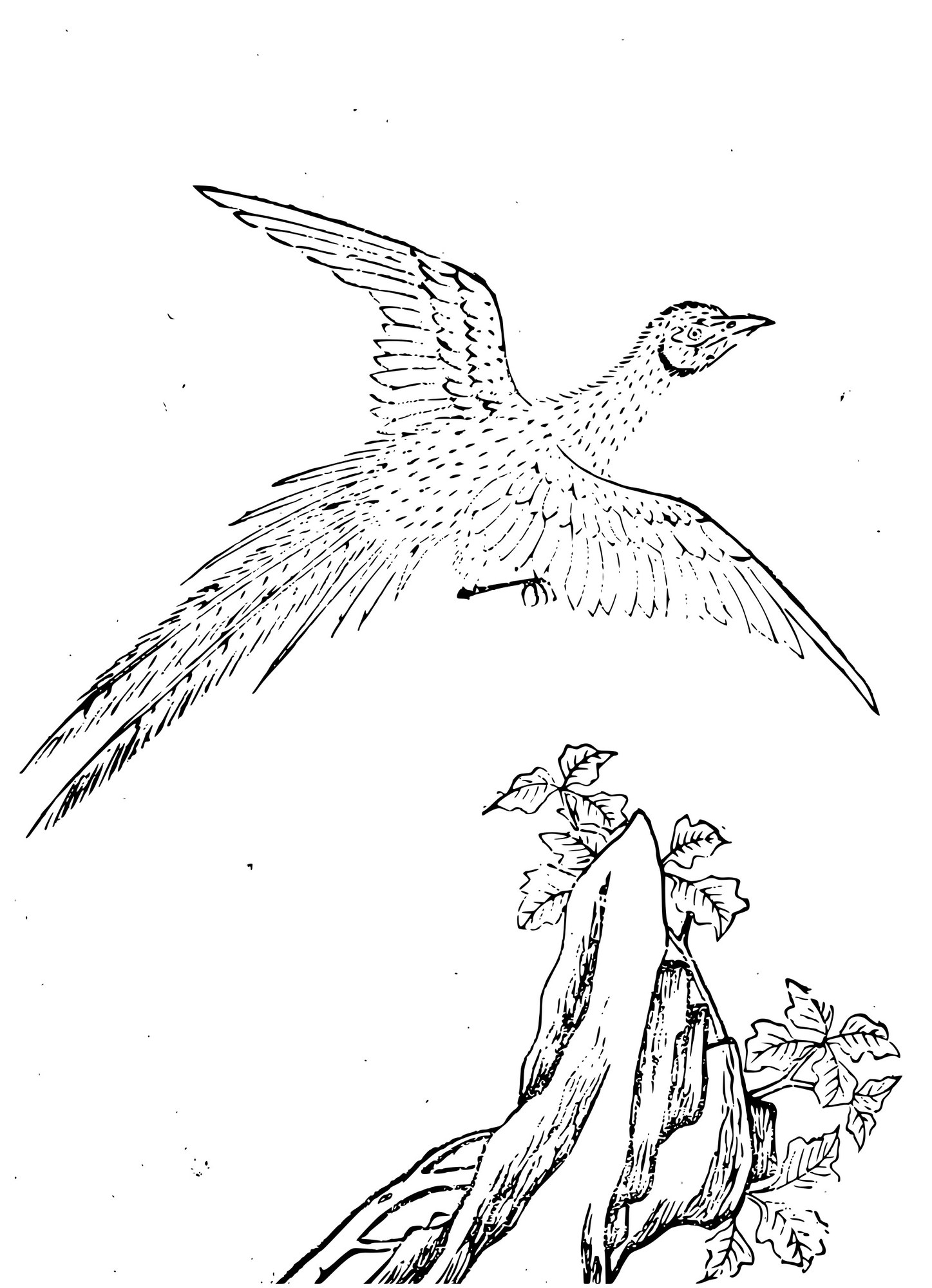
The girl went down to the Eastern Sea to play, and the water did not give her back. That is the whole of it, in the oldest telling, and the oldest telling does not soften it. She was the youngest daughter of a god, out roaming in the water the way a child goes roaming, and she could not return to shore, and she drowned. No monster took her. No god demanded her. The sea simply closed over a small girl on an ordinary outing, and closed the way water does, without malice and without exception.
Then she became a bird.
The girl who was the Flame Emperor’s youngest
Her name was Nüwa, and here the story sets a trap that has swallowed retelling after retelling. This Nüwa is not the great creator-goddess who patches the broken sky and moulds the first people out of clay. The two names sound alike and are written with different characters, and they are two entirely different beings: one a world-making deity, the other a drowned child. The girl of this story is 女娃, the daughter. The sky-mender is 女媧. Confusing them is the single most common error told about her, and it is worth getting right before anything else, because everything tender in the story depends on her being small and mortal and no one’s idea of a god.
She was the youngest daughter of YandiThe Flame Emperor (炎帝), a primordial agrarian culture-hero of Chinese tradition, often identified with the farming-god Shennong; here, the girl's father., and that is all the ancient source tells us of her life before the water. It does not describe her. It does not give her a single word of speech. It gives her a father, an outing, and a death, and then it turns, without pause or explanation, to what she became.
A crow-shaped bird that cries its own name
On Fajiu Mountain, whose heights are thick with cudrania, the mountain-mulberry the old silk-farmers prized, there lives a bird. The source describes it with the precision of a naturalist and the brevity of an epitaph: a body shaped like a crow, a patterned head, a white beak, red feet. It is a small, particular, findable creature: no phoenix, no numinous prodigy, just a bird you could imagine startling out of a real tree.
Its call sounds like jing-wei, and that cry is its name. She cries her own name, over and over, in a voice that says nothing else. The oldest text does not tell us she grieves and does not tell us she rages. It tells us only what she does, and what she does is this: she carries in her beak, endlessly, wood and stones from the Western Mountains, and drops them into the Eastern Sea to fill it in.
Consider the geometry of that labour. The Western Mountains lie at one edge of the world and the Eastern Sea at the other, and she ferries the mountain to the sea a twig and a pebble at a time, west to east, land into water, across the whole breadth of everything. And the land around her runs the other way: the Zhang River rises from her own mountain and flows east into the Yellow River, the water going where she cannot follow, downhill and seaward, while she labours uphill against the sea grain by grain. She is trying to undo the sea with the sea’s own mountains, and the sea is not measurably smaller for any of it.
What the ancient text does not say
Notice what the story withholds. The bare ShanhaijingThe Classic of Mountains and Seas, a compendium of geography and marvels compiled between roughly the 4th and 1st centuries BCE; the oldest source for this story. gives her no motive at all. It does not say she fills the sea to avenge herself, or to punish the water, or to spare the next child. It says she carries wood and stones and fills the sea, in the plain present tense of a thing that is simply always happening. The compulsion is total and the reason is blank, and that blankness is the most honest and most frightening part of the myth.
The vengeance came later. Centuries on, other texts gave her new names, the Oath-Bird and the Bird of Grievance, and with the names came a reading: that she fills the sea out of hatred for the water that drowned her. These names and this reading come from a source traditionally credited to a writer of around 500 CE, though the text as we have it is probably later still, perhaps three or four centuries on.
They reach us at all only through a Qing-dynasty anthology compiled around 1667, some eighteen hundred to two thousand years after the mountain-and-sea text first set the story down. That is a vast distance. The girl was drowning in that sea a very long time before anyone decided she was angry about it. If you want her vengeance, it is there in the tradition, but it is the tradition’s addition, not the myth’s own word.
Twigs against the vast blue sea
What the ancient myth gives instead of a motive is an image, and it was an image a poet could not leave alone. Around the fifth century CE, reading this same Classic of Mountains and Seas, Tao Yuanming fixed on Jingwei and made her the emblem she has been ever since: not of futility, though the labour is futile, but of a will that will not be told the labour is futile.
He set her beside XingtianA headless giant of a separate myth who dances brandishing axe and shield; the poet Tao Yuanming pairs him with Jingwei as a fellow emblem of unbroken will., the headless giant who goes on dancing and brandishing his axe with no head to lose, and made the two of them a single emblem. Between the ancient source and the poet who read it lies something on the order of five to eight centuries, and Tao’s Jingwei is a reading of the old bird, not a fresh report of her: he took a motiveless labourer and heard defiance in her, and the hearing has held for fifteen hundred years since.
She has, in the end, no chance. The blue-green sea is vast beyond filling and her beak holds one twig. But she does not stop, and the not-stopping is the point. The child the water took roams now on red feet through the mulberry heights, gathers what a small bird can carry, and flies it out over the water that drowned her, crying the two syllables of her own name into a sea that will never be a hand’s breadth shallower for anything she does. She keeps carrying anyway.
Jingwei carries tiny twigs, and means to fill the vast blue sea. (Tao Yuanming, Reading the Classic of Mountains and Seas, poem 10; author’s rendering from the Chinese)
- Shanhaijing (山海經), Beishan Jing (北山經, Classic of the Northern Mountains), c. 4th–1st c. BCE: the core text, containing the entire ancient myth in one paragraph — Fajiu Mountain thick with cudrania (柘); a bird shaped like a crow with a patterned head, white beak and red feet (其狀如烏,文首、白喙、赤足), named Jingwei, whose cry sounds like its own name (其鳴自詨); the bird is the youngest daughter (少女) of Yandi (炎帝), named Nüwa (女娃), who went roaming in the Eastern Sea, could not return and drowned (游于東海,溺而不返), and so became (故為) Jingwei, constantly carrying wood and stones from the Western Mountains to dam the Eastern Sea (常銜西山之木石,以堙于東海); the Zhang River (漳水) rises here and flows east. Chinese read verbatim (zh.wikisource 山海經/北山經). Standard EnglishRichard E. Strassberg, A Chinese Bestiary (Univ. of California Press, 2002), p. 18; Anne Birrell, The Classic of Mountains and Seas (Penguin, 1999).
- Tao Yuanming (陶淵明), 讀山海經 (Reading the Classic of Mountains and Seas), poem 10, c. 405–427 CE: the earliest and most influential poetic reception, an eight-line pentasyllabic poem opening 精衛銜微木,將以填滄海 (Jingwei carries tiny twigs, to fill the vast blue sea) and pairing her with the headless giant Xingtian (刑天舞干戚,猛志故常在), establishing Jingwei as the emblem of an unbroken will. Chinese read verbatim (zh.wikisource 讀《山海經》; editions vary between 猛志故常在 and 猛志固常在).
- Guo Pu (郭璞), commentary on the Shanhaijing, c. 276–324 CE: glosses 堙 (fill/dam) as 塞 (block up), identifies Yandi with Shennong, and supplies an illustration-eulogy (圖贊) — the Flame Emperor’s daughter, changed into Jingwei, her form drowned in the Eastern Sea, her spirit journeying west, carrying wood and stone to fill the ruinous waves (炎帝之女,化為精衛,沉形東海,靈爽西邁,乃銜木石,以填波害). Some six centuries after the core text. Read as quoted in Wu Renchen.
- Shu Yi Ji (述異記, Records of Strange Things), trad. attrib. Ren Fang (任昉, 460–508 CE); received text likely Tang, c. 6th–early 8th c. CE: the source of the alternate bird-names 誓鳥 (Oath-Bird), 冤禽 (Bird of Grievance), 志鳥 (Bird of Resolve) and the folk name 帝女雀 (Emperor’s-Daughter Sparrow), and of the grievance/vengeance framing that the base myth does not carry. Some seven hundred to a thousand years after the core text. Read as quoted in Wu Renchen, not in its own edition; the four names to be re-verified against a primary edition before printing as direct Shu Yi Ji quotation.
- Wu Renchen (吳任臣), 山海經廣注 (Shanhaijing Guangzhu, Expanded Commentary), Qing, c. 1667: the anthology that collects and attributes the variant quotations above, along with the near-identical Bowuzhi bird-description (Zhang Hua, c. 290 CE), the late
no male mate; pairs with the sea-swallow
gloss, and the geographic identifications placing Fajiu Mountain in Shangdang (present-day southeast Shanxi) near the source of the Zhuo Zhang river — consistent with the Shanhaijing’s own Zhang-River note. Some eighteen hundred to two thousand years after the core text. Chinese read verbatim (zh.wikisource 山海經廣注 (四庫全書本)/卷03).