The invitation came dressed as friendship. Dhritarashtra, the blind Kuru king, sent his half-brother Vidura to Indraprastha to summon the sons of Pandu to Hastinapura, to sit, the message said, to a friendly match at dice. Vidura carried it, but did not pretend to believe in it. I know that gambling is the root of misery, he told Yudhishthira plainly, and I strove to dissuade the king from it. The eldest of the PandavasThe five brothers Yudhishthira, Bhima, Arjuna, Nakula and Sahadeva, sons of Pandu and joint husbands of Draupadi, whose losses at the board drive the scene. understood exactly what was being offered him. If we sit to a match at dice, he said, we may quarrel. Then he went anyway, because a rule stronger than his own judgement had him by the throat.
The vow that could not refuse
That rule was the warrior’s code. Yudhishthira held to a KshatriyaThe warrior and ruling order of ancient India, bound to a code that Yudhishthira invokes twice as the reason a summoned king may not refuse a game. vow he would not break: if challenged, he would never refuse, for that, as settled, was his eternal vow. He is called the just
and the son of Dharma,
and the tragedy of the scene is that his ruin comes from an excess of principle, not a vice. He walks into Hastinapura knowing he should not, because to turn back would be to fail a different duty. The trap was built precisely around the one man too righteous to escape it.
He did not even play his enemy directly. Duryodhana, eldest of the hundred KauravasThe hundred sons of the blind king Dhritarashtra, led by Duryodhana, hosts of the dice-hall and rivals of the Pandavas for the Kuru throne. and the architect of the invitation, would supply the wealth, but the dice would be rolled by his maternal uncle Sakuni, king of Gandhara, a man adept at the board and desperate in his stakes. Yudhishthira objected that gambling for one man’s sake through the hand of another seemed to him contrary to rule. He was right, and it changed nothing. Sakuni took up the dice, and the text says flatly that he won by adopting unfair means. His verdict after every throw was the same three words, a drumbeat under the whole disaster: Lo, I have won.
Everything on the board, in order
The losses came in a rising order the epic counts out with terrible patience. First a pearl necklace churned of old from the ocean and decked with gold. Then the treasuries of gold and silver. Then a royal car drawn by eight steeds white as moonbeams, hung with little bells whose clatter was like the roar of clouds. Then a hundred thousand serving-girls, a thousand serving-men, a thousand rutting elephants, chariots and warriors, whole breeds of horses, all the cattle from one river to another, and at last the city itself, the land, and the persons of his subjects. Throw after throw, the answer was the same: Lo, I have won.
When there was nothing left outside himself, Yudhishthira began to stake his own blood. He lost Nakula, then Sahadeva, then Arjuna, then Bhima, the four brothers gambled away one by one while the elders Bhishma, Drona and Kripa sat behind with cheerless hearts. Then he staked himself, still unwon, and lost. And then Sakuni leaned in with the cruellest prompt of all. There is still one stake dear to thee that is unwon, he said.
Stake thou the princess of Panchala. By her, win thyself back. Yudhishthira described her beauty at length, put her on the board, and lost her too. The assembly cried out, Fie, fie. Bhishma and Drona broke into sweat. Vidura sat with his head in his hands. And the blind king in his palace kept asking the one question his greed could not hold in: hath the stake been won, hath the stake been won?
A slave with nothing left to stake
Here the story stops being a tale of ruin and becomes a courtroom, and the case it argues has never quite closed. Duryodhana ordered Draupadi fetched to sweep the women’s chambers. Vidura refused outright and ruled that she was not lawfully won, because the king had staked her after he had already lost himself and ceased to be his own master. A man who is himself a slave owns nothing, and so can wager nothing. This is the hinge the whole episode turns on, and it comes not as a miracle but as a point of law.
Draupadi drove it home herself. When Duryodhana sent a herald instead of going, she sent back a single question for the hall to answer: go and ask that gambler whom he lost first, himself or me. Yudhishthira sat silent, like one demented, and never answered. He could not, because no answer failed to damn him. The most righteous man in the story had reduced himself to a slave who had gambled away a queen he no longer had the standing to touch, and his silence is louder than any of Sakuni’s throws.
Dragged into the hall
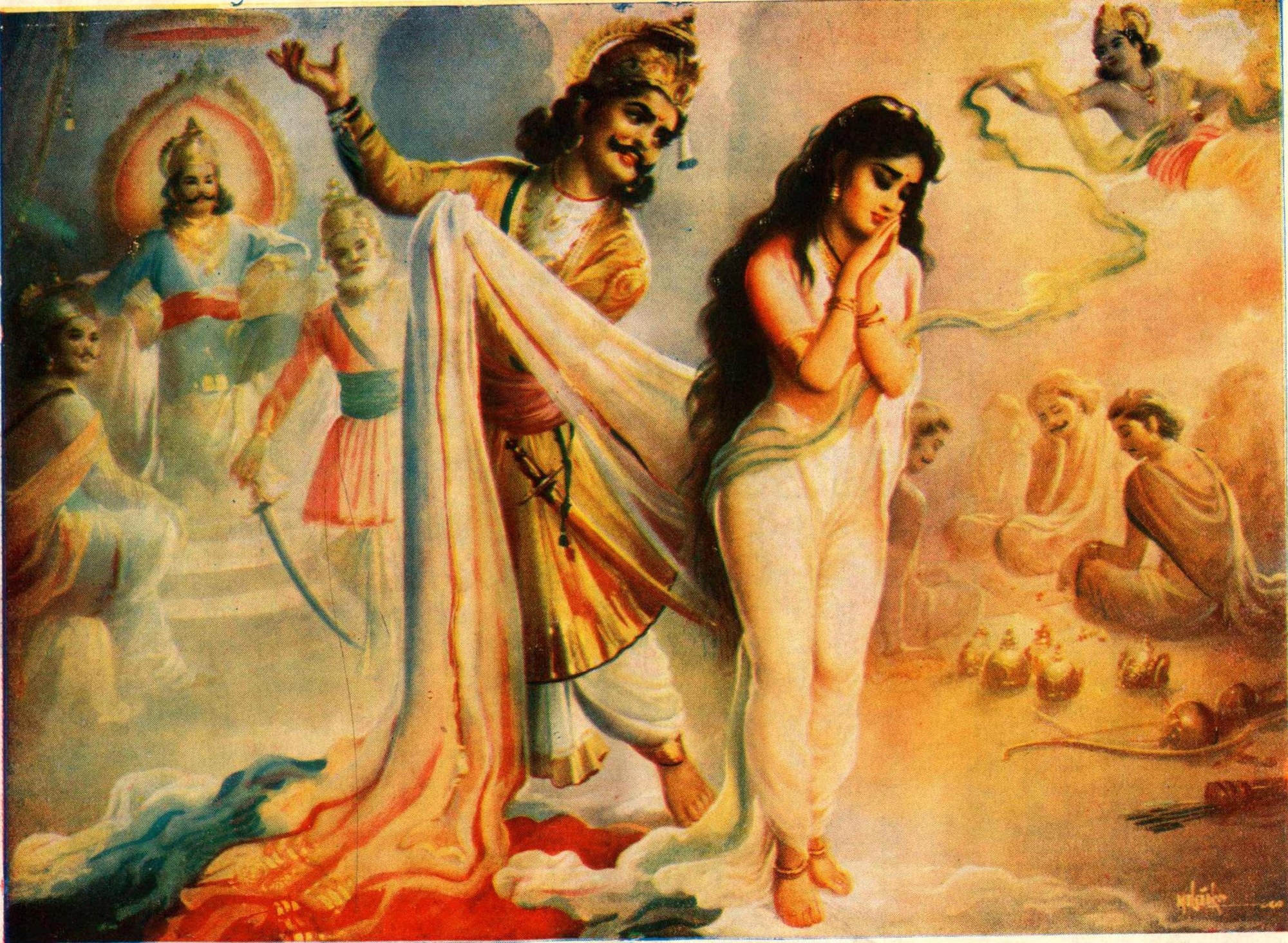
When the herald faltered, Duryodhana sent his brother Duhshasana. He ran at her roaring, seized her by her long dark hair, hair still wet, the text is careful to say, with water sanctified with mantras in the great RajasuyaThe great royal consecration sacrifice; the water that sanctified Draupadi''s hair at that rite makes the seizing of it in open court a double outrage. sacrifice, and dragged her into the assembly of men. She was in a single garment because her season had come, and Duhshasana threw even that in her face: whether thy season hath come or not, he sneered, when thou hast been won at dice thou art our slave. She trembled, the epic says, like a banana plant in a storm.
She appealed to the code, and the code failed her one voice at a time. Bhishma, the grand-uncle who might have stopped it, retreated into evasion: morality is subtle, he said, and would not rule whether she was won. Only Vikarna, one of Dhritarashtra’s own sons, stood and declared her unwon, on the ground that a man already lost cannot stake another. Karna shouted him down, called Draupadi unchaste for having five husbands, pronounced her justly won, and gave the order: take off the robes of the Pandavas, and the attire of Draupadi.
Hundreds of robes, and no agreed hand
What follows is the most famous image in the episode and, of all its parts, the one the primary text handles most carefully. As Duhshasana dragged at her garment, Draupadi cried aloud on Krishna, who was not in the hall: O Govinda, O Kesava, rescue me who am sinking in the Kaurava ocean. And cloth began to appear. As one robe was pulled away another of the same kind was already beneath it, and another, hundreds upon hundreds of robes of many hues, until a mass of cloth lay heaped on the floor and Duhshasana, exhausted and ashamed, sat down.
Who saved her is a genuine divergence in the tradition, not a matter of phrasing. In the Ganguli vulgate text quoted here, she calls out to Krishna, but the endless cloth is supplied by the god Dharma, remaining unseen; Krishna is moved and comes on foot, yet the text does not say he furnished the robes. The near-universal retelling in temple discourse, art and film credits Krishna himself, personally and by his grace, a version theologically central to Vaishnava faith but laid over the base text rather than found in it.
The Poona critical editors, reconstructing the oldest recoverable Sabha Parva, found the miracle absent from the archetype altogether: in that stripped-back text there is no cloth, only the human rescue that comes next. The witnesses that carry the miracle and the one that omits it are separated by centuries of the epic’s growth, and the site does not pretend they agree.
The human rescue arrived through the blind king’s fear. Ill omens broke over the hall, a jackal howling, asses braying, birds shrieking, and Dhritarashtra, frightened of what they foretold, at last intervened. He consoled Draupadi and granted her boons. She asked two: that Yudhishthira be freed from slavery, and her four other husbands with their weapons.
Offered a third, she declined, saying a Kshatriya woman may ask only two. The kingdom was restored and the Pandavas sent home. But the fire was already lit. Bhima had sworn, in the middle of it all, to open Duhshasana’s breast in battle and drink his blood, and Duryodhana had bared his thigh and invited the queen to sit on it, earning a second oath to break it.
“Tearing open in battle, by sheer force, the breast of this wretch… if I do not drink his life-blood, let me not obtain the region of my ancestors.” (Mahabharata, Sabha Parva, Anudyuta Parva)
It was not finished. Duryodhana, Karna and Sakuni talked the king into recalling the Pandavas for one last throw, over Gandhari’s plea, and this time the single stake was exile: twelve years in the forest and a thirteenth in hiding. Yudhishthira, summoned, could not refuse, and lost on one cast. The brothers cast off their royal robes, put on deer-skins, and walked out toward the forest with Draupadi while Duhshasana jeered. The whole war of Kurukshetra, the emptying of a subcontinent of its warriors, runs on the fuse lit that day, when a righteous king kept a vow he should have broken and could not answer a woman’s question.
- Mahabharata, Sabha Parva (Book 2), Dyuta Parva, Sections LVIII–LXXIII, trans. Kisari Mohan Ganguli (P. C. Roy edition, Calcutta, 1883–1896)the summons and Vidura’s disapproval, Yudhishthira’s vow, Sakuni’s rigged play and its refrain, the ordered stakes down to Draupadi, the
did he lose himself first
question, the seizure and dragging, Bhishma’s evasion, Vikarna’s lone defence, Karna’s order to strip the robes, the cloth multiplied by Dharmaremaining unseen,
Bhima’s oaths, the thigh insult, and Dhritarashtra’s boons. - Mahabharata, Sabha Parva (Book 2), Anudyuta Parva, Sections LXXIV–LXXVII, same editionthe recall over Gandhari’s plea, the single exile-stake, the loss on one throw, and the departure into exile.
- Poona / BORI Critical Edition of the Sabhaparvan (ed. Franklin Edgerton, gen. ed. V. S. Sukthankar, 1943–44)cited for the finding that the cloth-miracle is absent from the reconstructed archetype, so that in the oldest text the rescue is Dhritarashtra’s intervention alone.