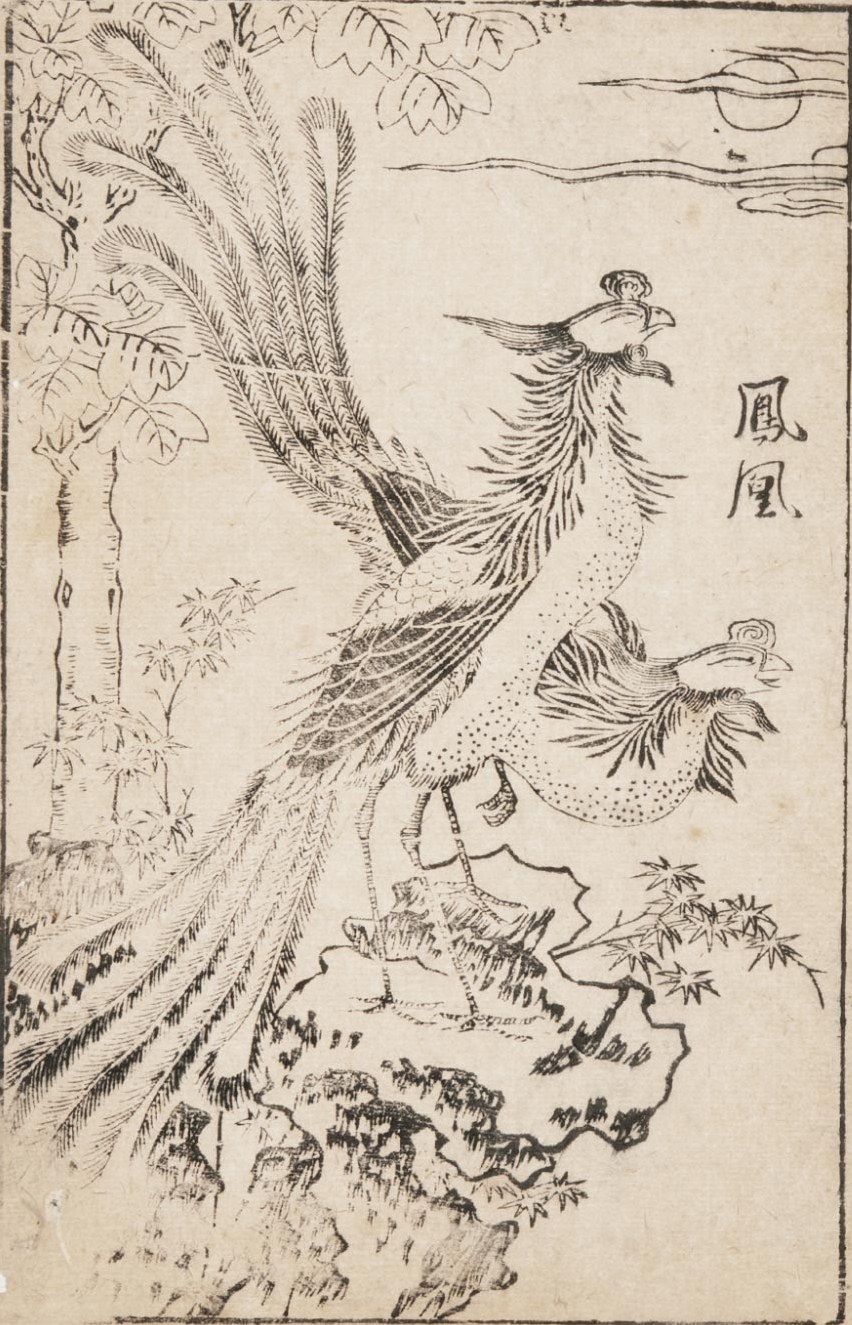
Imagine a bird shaped like an ordinary fowl, no larger, standing in a clearing on a cinnabar-red mountain in the far south. It bears all five colours at once, and its feathers are not merely coloured but marked, as though a hand had written on them. On its head stands the graph for virtue. Across its wings, righteousness. On its back, ritual; on its breast, benevolence; on its belly, good faith. It takes its food and drink as nature provides, sings to no one but itself and dances for its own delight, and it is seen only in one circumstance: when all under heaven is at peace. This is the fenghuang, and the oldest source to describe it treats it as a proclamation with wings.
That description comes from the Shanhaijing, the Classic of Mountains and Seas, in its chapter on the southern mountains. The sighting is fixed at a place called Mount Danxue, Cinnabar-Cave Mountain, a red name in a red country. What the earliest text gives is spare and exact: a fowl-shaped bird, five-coloured and patterned, the five graphs each in their place, self-feeding and self-delighting, and the single, load-bearing clause that it appears when the world is at rest.
Feathers that can be read
The strangest claim in that oldest passage is not the colour but the writing. The bird’s markings are wenThe word for a pattern or written graph alike; the fenghuang's feathers are said to bear wen, markings that are also legible characters., and the word does double duty in Chinese: it means a pattern, the kind a leopard wears, and it means a written character, the kind a scribe brushes. The Shanhaijing exploits both senses at once. The pattern on the head is not merely head-shaped decoration; it is the graph De, virtue, legibly present in the plumage. The wings carry Yi, righteousness. The back carries Li, ritual propriety. The breast carries Ren, benevolence, the cardinal Confucian virtue. The belly carries Xin, good faith. The bird is a moral document you could in principle read off its body, feather by feather.
It is worth keeping the ordering exactly as this text gives it, because later retellings shuffle the graphs from limb to limb and tidier schemes crept in over the centuries. The only sequence with a source here is the Shanhaijing’s own: head, wings, back, breast, belly, in that order. And the five colours are simply five colours complete.
The text never names which five, and the honest reading does not invent a palette it does not offer.
One bird, or a pair
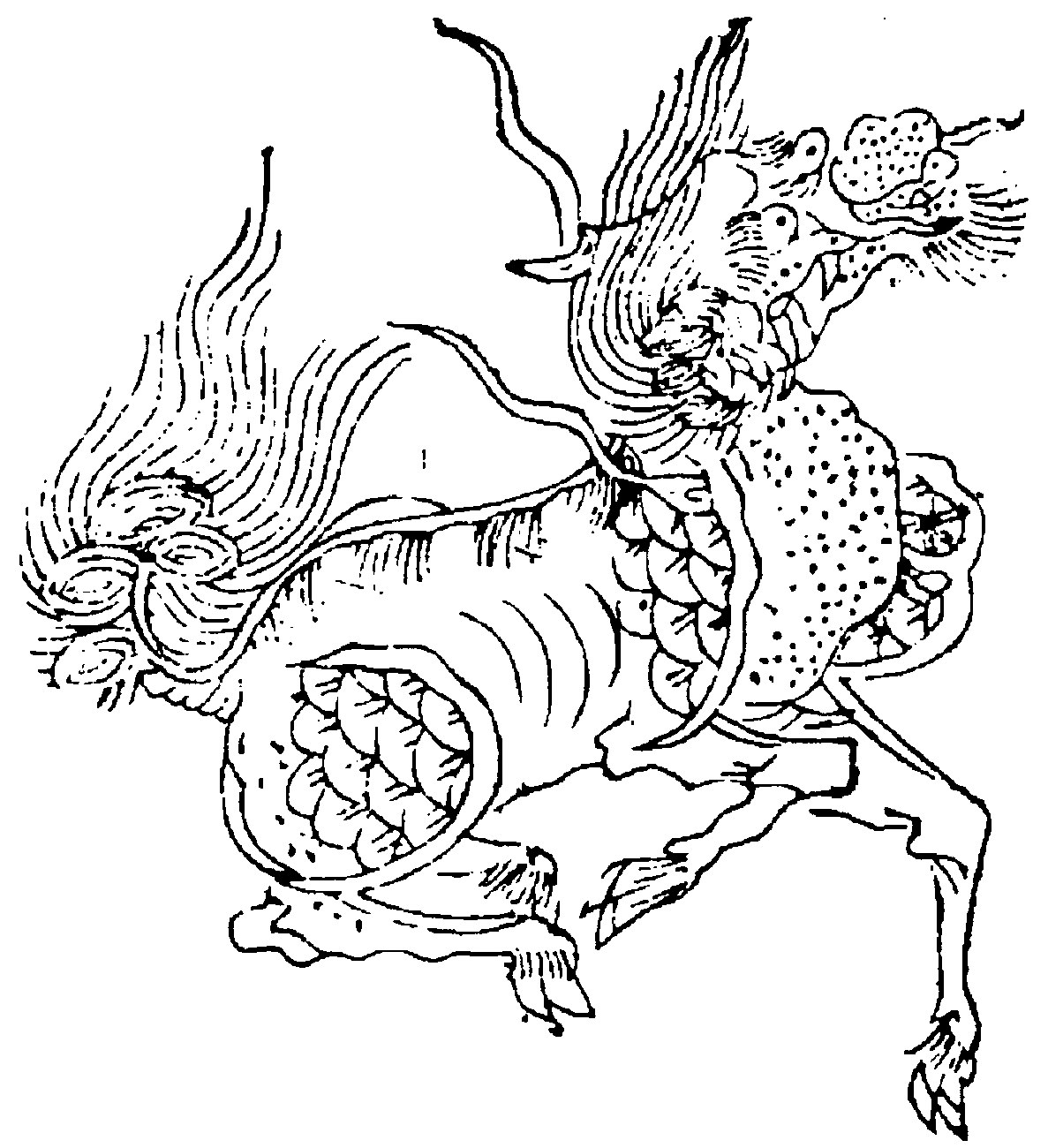
By the time of the Shuowen Jiezi, Xu Shen’s great dictionary of around 100 CE, the plain fowl-shaped bird has grown a far more elaborate body. Here the feng is a divine bird assembled out of pieces of other creatures: the forequarters of a wild goose and the hindquarters of a qilin, the neck of a snake and the tail of a fish, the forehead of a stork, the markings of a dragon and the back of a tiger, the chin of a swallow and the beak of a fowl.
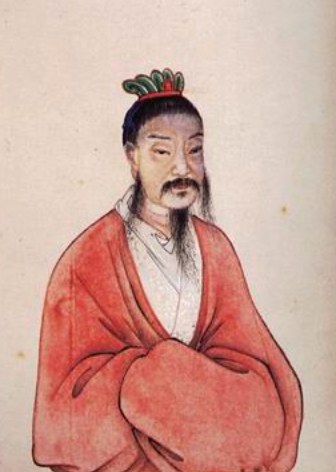
Xu Shen does not claim this composite as his own observation. He attributes it to Tian Lao, a legendary minister of the Yellow Emperor, framing the chimera as received lore rather than fact.
Two things are worth flagging about this richer picture, and both are matters of distance. First, the Shuowen stands two to four centuries after the Shanhaijing’s plain description; the elaborate patchwork anatomy is a later accretion, not part of the oldest sighting. Second, the split into a mated pair, the male feng and the female huang that fuse into the modern word fenghuang, comes later still.
It is not in the Shanhaijing base text at all. It surfaces in the commentary tradition, in a gloss carried on the same page as the ancient passage but written by Guo Pu around the early fourth century CE, roughly six hundred years after the Warring States core he was annotating. The ancient bird is one bird. The couple is the reading of a much later hand.
The Land of the Gentlemen in the East
The Shuowen also gives the creature a geography, and it is gorgeous. The feng comes forth from the Land of the Gentlemen in the East, soars beyond the Four Seas, passes over Kunlun, drinks at the Dizhu rock in the Yellow River, washes its feathers in the Weak Water, and roosts at nightfall in the Wind Cave. It is a circuit of the edges of the world, drawn between named and half-mythical places, and it ends each night in a cave named for the wind. Xu Shen closes on the same note the Shanhaijing struck: when this bird is seen, all under heaven is in great peace, the omen sharpened here by the single added word for great.
Among the trees of the suburbs
The third old witness is not a bestiary but a book of ritual. The Liji, the Record of Rites, in its chapter on the conveyance of rites, lists the feng among the silingThe four numinous creatures of Chinese ritual thought (qilin, phoenix, tortoise and dragon), whose appearance the Liji reads as the sign of a sage-king's reign., the four numinous creatures: the qilin, the phoenix, the tortoise and the dragon. These are the beasts whose very tameness measures a reign. When the dragon is a domestic animal, the Liji says, the fishes do not hide; when the phoenix is tame, the birds do not flee in terror. In the age of the sage-kings, James Legge’s 1885 rendering has it, phoenixes and qilins were among the trees of the suburbs,
present and unafraid at the edges of a well-ordered realm.
This is the thread that binds all three texts across their gap of six to eight centuries. The Shanhaijing of the Warring States, the Liji compiled under the Western Han, and the Shuowen of the Eastern Han do not describe the same bird in the same words, and they disagree on its anatomy and its number. But every one of them makes the fenghuang a reading of the times. It cannot appear in a cruel or warring age. Its presence is not decoration but diagnosis: the world is at peace, and here is the proof, standing in the suburb trees with the virtues written on its back.
There is a bird here, shaped like a fowl, five-coloured and patterned. It is called the fenghuang. When it is seen, all under heaven is at peace. (Shanhaijing, “Nanshanjing”; author’s rendering from the Chinese)
Not the phoenix of the ashes
One last thing the sources do not say. The fenghuang is often called the Chinese phoenix in English, and Legge himself translated feng as phoenix.
But the equation is a translator’s convenience, not a claim in any of these texts. The Mediterranean phoenix dies in fire and is reborn from its own ashes; nothing of that belongs to the fenghuang. It does not burn, does not die, does not rise again. In the Shanhaijing, the Shuowen and the Liji alike it neither perishes nor resurrects. It simply comes, when the age deserves it, five-coloured and inscribed, and is gone again when the age does not.
- Shanhaijing (山海經), Nanshanjing (南山經), core stratum c. 4th–1st c. BCE (received text edited by Liu Xiang/Liu Xin; annotated later by Guo Pu, c. 276–324 CE): the Mount Danxue (丹穴之山) entry — a fowl-shaped, five-coloured, patterned bird whose head-pattern reads De (德, virtue), wing-pattern Yi (義, righteousness), back-pattern Li (禮, ritual), breast-pattern Ren (仁, benevolence) and belly-pattern Xin (信, good faith); it eats and drinks in accord with nature, sings and dances of itself, and when seen all under heaven is at peace (「有鳥焉,其狀如雞,五采而文,名曰鳳皇,首文曰德,翼文曰義,背文曰禮,膺文曰仁,腹文曰信。是鳥也,飲食自然,自歌自舞,見則天下安寧。」). Chinese read verbatim; English is the author’s literal gloss.
- Shuowen Jiezi (說文解字), Xu Shen (許慎), c. 100 CE (presented 121 CE, Eastern Han): headword 鳳 — the feng as a divine bird (神鳥) with a composite form attributed to Tian Lao (天老)goose-fore and qilin-hind, snake-neck and fish-tail, stork-forehead and mandarin-duck, dragon-markings and tiger-back, swallow-chin and fowl-beak, the five colours all complete; its circuit from the Land of the Gentlemen in the East beyond the Four Seas, over Kunlun, drinking at Dizhu, washing its feathers in the Weak Water, roosting in the Wind Cave; and the omen-of-great-peace formula 見則天下大安寧. Chinese read verbatim; English is the author’s literal gloss.
- Liji (禮記), Liyun (禮運, The Conveyance of Rites), Western Han compilation (Dai Sheng recension, 1st c. BCE): the feng among the four numinous creatures (四靈, siling) — qilin, phoenix, tortoise, dragon — whose taming marks the reign of the sage-kings (「麟、鳳、龜、龍,謂之四靈」), and phoenixes and qilins
among the trees of the suburbs
(「鳳皇、麒麟皆在郊棷」). English quoted verbatim from James Legge, The Sacred Books of the East vol. 27 (Oxford, 1885), Li Yun Sect. III. - Guangya (廣雅), Zhang Yi (張揖), c. 227–232 CE (later — a variant, quoted secondhand in the Shanhaijing annotations): a divergent composite anatomy (fowl-head, swallow-chin, snake-neck, tortoise-back, fish-tail); and Guo Pu’s gloss 「雌曰凰,雄曰鳳」 (the female is huang, the male is feng), the origin of the modern paired 鳳凰, roughly six centuries younger than the Nanshanjing core.