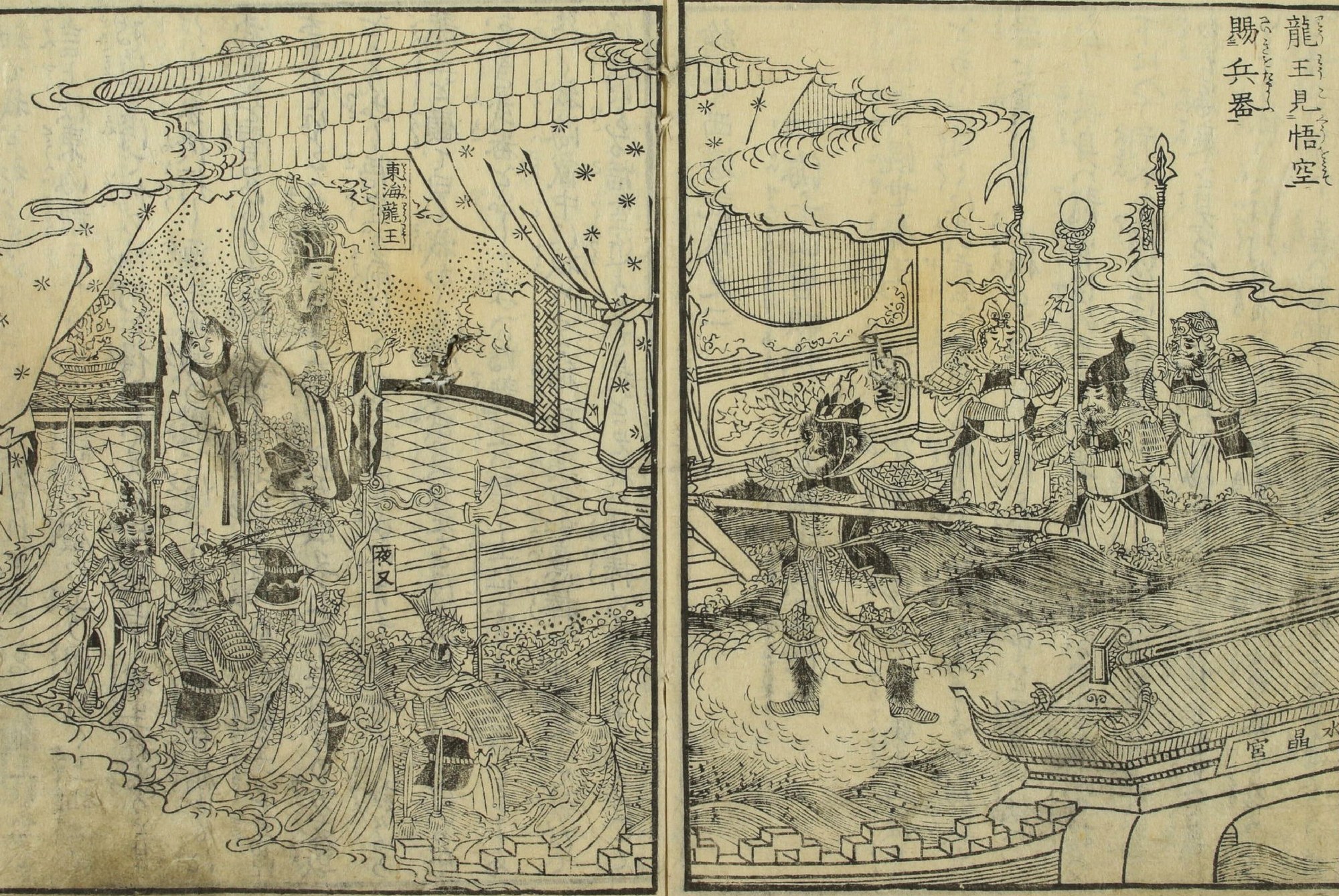
Beat an iron drum and strike a golden bell under the Eastern Sea, and in an instant four brothers come. They are dragon kings, one to each of the four seas, and the eldest keeps a court of crystal where dragon sons and dragon grandsons wait on him and his soldiers are shrimp and his generals are crabs. This is the picture almost everyone carries of the Chinese dragon king: a royal quartet of sea-lords, surnamed Ao, ruling the waters in a bureaucracy of coral and pearl. It is a wonderful picture, and it is late. The tidy four-brother line-up is younger than the Yellow River, younger than the Mahayana that gave the dragon his crown, younger by many centuries than the rain-dragon it is built on.
Set the pieces end to end and the span is startling. A rain-dragon of the elements is Han cosmology, fixed by about 139 BCE. The royal title dragon king
is a Buddhist import of the first century CE. The four named brothers with their palace and their court do not appear until a Ming novel of the 1590s. Between the first strand and the last lies something like seventeen hundred years. To call the four sea-brothers the ancient Chinese dragon gods
is to read the last page of a very long book as if it were the first.
Dragons of the five directions, before any crown
The oldest layer has no king in it at all. In the Huainanzi, the great cosmological compendium presented at the Han court around 139 BCE, dragons come in five colours keyed to the five directions and the five phases: a yellow dragon at the centre, a blue-green one in the east, red in the south, white in the west, black in the north, each generated out of the earth-force of its own quarter. These are elemental beings, part of the machinery by which the cosmos is sorted into fives. They rule no seas. Not one of them is called a king. They are closer to the colours on a diviner’s board than to a sovereign on a throne.
What these five-coloured dragons did have was a job: rain. The Han reached for coloured dragons in the business of making it fall, moulding earthen dragon-figures of the season’s proper colour and setting each at its assigned point of the compass to draw down water in a drought. This is the dragon the whole later tradition grows out of, and the thing to hold onto is what he is not yet. He has no name, no brothers, no undersea hall. He is weather, personified and colour-coded, a lever the ritual specialist pulls when the fields go dry.
A title carried in from India
The word that turns a rain-dragon into a dragon king is not native. Dragon king
, 龍王, is a Buddhist loan, the standard Chinese rendering of the Sanskrit nāga-rāja, the serpent-sovereign of Indian myth, and it enters the language with Buddhism in the Eastern Han, around the first century of our era. The five-direction dragon was already Chinese and already old; the royal collar laid over him was borrowed, and borrowed centuries after he first appeared. The earliest text known to title the five colour-dragons outright as kings is an apocryphal scripture of the early fourth century. The concept is homegrown; the kingship is an overlay, and dating the two together is the commonest way to get this figure wrong.
That overlay reaches its fullest ritual form in the Daoist scriptures. The Taishang dongyuan shenzhou jing, whose core is of the fourth or fifth century though the text we read is a Tang redaction, gives a whole chapter to dragon kings, and it lists them twice over. First the five-emperor dragon kings, one to each direction and one at the centre, the old five-colour scheme now crowned. Then, in the same chapter, a set of four sea kings, titled only by their seas, who come floating through the air and in a single moment spit out ten thousand measures of water against fire and drought.
Chant the spell three days and nights over incense and, the scripture promises, in a drought it will then rain. Write the four sea kings’ names at the four corners of your house and the flames will keep their distance. Here, plainly, is the working dragon king: a rain-clerk and a fire-ward, summoned by rite, entirely without a personality. He has no name of his own, no surname, no crystal hall. He is a direction and a function.
The brothers get their names
Everything that makes the dragon king a character, rather than a slot in a litany, arrives with the Ming novel. In the XiyoujiJourney to the West (西遊記), the Ming vernacular novel of about the 1590s, conventionally credited to Wu Cheng'en, in which the four sea-brothers first hold their names and their crystal-palace court., the four sea kings finally step forward as individuals: brothers who share the surname Ao. The eldest, of the Eastern Sea, is Ao Guang; his three younger brothers, he says himself, are Ao Qin of the South, Ao Shun of the North, and Ao Run of the West.
Ao Guang’s Crystal Palace under the Eastern Sea is a functioning court, staffed by dragon sons and dragon grandsons, defended by soldiers who are shrimp and generals who are crabs, and the four brothers are summoned to it by beating an iron drum and striking a golden bell, at which they arrive in an instant.
It is worth being exact about how much of the familiar image belongs only to this stratum. The surname Ao, the palace of crystal, the shrimp-and-crab court, the brotherhood of four: none of it is in the Daoist litany or the Han cosmology. All of it is novelistic, sixteenth-century, the vernacular imagination filling an abstract ritual slot with a living cast.
Even the names are not stable across the tradition. The rival novel Fengshen yanyi and other tellings give a partly different set, so that the same throne of the same sea carries different names in different books. There is no single canonical roster of the four; there is a most famous one, and it is the one the Xiyouji prints.
What the sea-king keeps
The novel’s dragon king is also a treasury, and his most consequential possession is an heirloom out of far older myth. When the monkey Sun Wukong comes to the Crystal Palace demanding a weapon, Ao Guang cannot fit him, until the monkey helps himself to a glowing iron pillar from the sea-hoard: an object that was, the story says, the depth-gauge Yu the GreatThe flood-taming culture hero (大禹) who, in the received tradition, channelled the great deluge and whose measuring-rod for the depth of rivers and seas becomes Sun Wukong's iron cudgel. used in taming the great flood, the rod by which he fixed how deep the rivers and seas should run.
It answers to its wielder’s wish, shrinking and growing to order, and its inscribed name and weight are given plainly, a compliant golden-hooped cudgel of thirteen thousand five hundred cattiesA Chinese unit of weight (斤, catty), so that the cudgel's inscribed 13,500 catties marks it as a burden no ordinary hand could lift.. To be rid of their unwelcome guest the four brothers then arm him outright, each surrendering a piece of regalia. The scene fixes what the dragon king has become: not a weather-spirit but a lord with a hoard, rich enough to arm a demon and grand enough to be robbed by one.
Bound by the edict of Heaven
For all the crystal and gold, the dragon king never stops being Heaven’s rain-clerk, and one episode in the same novel makes the old subordination unforgettable. The Jing River Dragon King, a lord of a river rather than a sea, receives an edict from the Jade EmperorThe supreme celestial sovereign (玉帝) of the later Chinese pantheon, to whom the dragon kings answer as rain-officers under edict. that fixes to the hour and to the inch the rain he is to let fall on the city of Chang’an.
To win a wager with a fortune-teller who has predicted the storm exactly, he tampers with the order: he shifts the timing by an hour and shaves the quantity. It is a small cheat, and it is a capital crime. He has, the verdict runs, violated the Jade Emperor’s edict, changed the hour, cut short the count, and broken the law of Heaven, and for it he is sentenced to be beheaded at the Dragon-Execution Terrace, the sentence carried out by a mortal minister of the Tang court who does the deed in a dream.
The scene is the Daoist rain-officer of the scriptures dramatised as tragedy. A dragon king is not a free lord of storms; he is a functionary of the sky, handed a docket that names the very hour and the very inches, and answerable with his head when the rain is delivered wrong. The Crystal Palace and the crab generals are the Ming novelist’s embroidery. This, the bond of the rain to the edict, is the older thing showing through, the same premise the scriptures set out when they had the sea kings spit their ten thousand measures of water only on command.
The dragon before he was a king
It helps to see what the figure looked like before the crown was fitted at all. Two hundred years before the earliest crowned dragon king, in Gan Bao’s Soushen ji of around 350 CE, there is a rain-dragon with no royalty about him. In a drought the farmers of a northern commandery go to pray at a dragon-cave, and a sage who passes diagnoses the resident dragon as simply unwell, its sickness the reason its rain has turned foul.
The dragon is cured, and in gratitude it bores them a well. There is no king here, no palace, no court of shellfish, no surname. There is a local dragon in a hole in the ground, sick and then grateful, tied to a village shrine. Across the whole of that book, the very phrase dragon king
never once appears.
That is the true shape of the thing. The dragon king of the four seas, brothers surnamed Ao in their palace of crystal, is not an ancient inheritance but a long accumulation: a Han rain-dragon of the five directions, an Indian royal title fitted over him around the first century, a Daoist litany of nameless sea kings, and at the very end a Ming novelist’s four brothers with their drum and bell and hoard. The most famous layer is seventeen centuries younger than the oldest, and it wears his one steady job, the making of rain, like a crown it was handed late.
My younger brothers are the South Sea Dragon King Ao Qin, the North Sea Dragon King Ao Shun, and the West Sea Dragon King Ao Run. (Xiyouji, ch. 3; author’s rendering from the Chinese)
- Xiyouji (西遊記, Journey to the West), ch. 3, attributed to Wu Cheng’en (吳承恩), c. 1590s (Ming): the four brother Dragon Kings named and set to the seas (East Ao Guang 敖廣, South Ao Qin 敖欽, North Ao Shun 敖順, West Ao Run 敖閏), with Ao Guang naming his three younger brothers verbatim (舍弟乃南海龍王敖欽、北海龍王敖順、西海龍王敖閏是也); the Crystal Palace (水晶宮) with its dragon sons and grandsons and shrimp soldiers and crab generals (龍子龍孫、蝦兵蟹將); the summoning by iron drum and golden bell (鐵鼓、金鐘); the sea-treasury pillar taken as the Ruyi Jingu Bang (如意金箍棒), Yu the Great’s flood-depth gauge (定江海淺深的一個定子) inscribed at 13,500 catties (重一萬三千五百斤); and the three regalia — cloud-stepping shoes (藕絲步雲履), a chainmail golden cuirass (鎖子黃金甲), a phoenix-wing purple-gold cap (鳳翅紫金冠). Chinese read verbatim (zh.wikisource.org/wiki/西遊記/第003回).
- Xiyouji (西遊記, Journey to the West), ch. 10, c. 1590s (Ming): the Jing River Dragon King (涇河龍王), the rain-officer who alters the Jade Emperor’s (玉帝) edict on the hour and inches of rain over Chang’an (明朝施雨澤,普濟長安城), shifting the time and cutting the count (改了他一個時辰,剋了他三寸八點), and is condemned for having
broken the law of Heaven
(違了玉帝敕旨,改了時辰,剋了點數,犯了天條) to beheading at the Dragon-Execution Terrace (剮龍臺) by the minister Wei Zheng (魏徵). Chinese read verbatim (zh.wikisource.org/wiki/西遊記/第010回). - Taishang dongyuan shenzhou jing (太上洞淵神呪經), juan 13,
Dragon King Chapter
(龍王品): Daoist; scriptural core 4th–5th c., received text a Tang redaction (Du Guangting 杜光庭 preface, 9th–10th c.), in the Daozang. The five-emperor / five-colour dragon-king litany verbatim (東方青帝青龍王…中央黃帝黃龍王); the anonymous, direction-titled four-seas dragon kings who come floating through the air andspit out ten-thousand shi of water
(吐水萬石) against fire and drought; the three-day rain-spell (in drought, then it rains
, 時旱即雨); and the four sea kings’ names written at a house’s four corners to ward off fire. No proper names, no surname Ao, no palace. Chinese read verbatim (zh.wikisource.org/wiki/太上洞淵神呪經). - Huainanzi (淮南子),
Dixingxun
(墬形訓), c. 139 BCE (Former Han): the five colour-and-direction dragons (yellow centre, blue-green east, red south, white west, black north), each generated from the earth-force of its quarter (黃金千歲生黃龍…青金…生青龍…). Elemental cosmology with no king (王) title and no sea-rulership — the pre-Buddhist substrate. Chinese read verbatim (zh.wikisource.org/wiki/淮南子/墜形訓). - Soushen ji (搜神記), Gan Bao (干寶), juan 20, c. 350 CE (Eastern Jin): the un-royal rain-dragon — a sick dragon of a dragon-cave (龍洞) healed by the sage Sun Deng (孫登) that repays the cure by boring a well (穿井以報). No king, no palace, no court; and across all 20 juan the phrase
dragon king
(龍王) appears nowhere. Cited as the pre-royal layer, not as evidence of the four sea kings. Chinese read verbatim (zh.wikisource.org/wiki/搜神記). - Secondary scholarship (interpretation, not primary): Monta (2012) on the five-direction dragons as Former-Han cosmology,
dragon king
(龍王) as a Buddhist loan for nāga-rāja, and the Foshuo guanding jing (佛說灌頂經, early 4th c.) as the earliest text titling the five-colour dragons as kings; Faure (2005) pp. 76–77 on the drift from the fivefold to eight- and twelvefold schemes; Overmyer (2009) pp. 20–21 on the modernDragon King of the Four Seas, Five Lakes, Eight Rivers and Nine Streams
; Idema (2008) on the Ao Guang–Sāgara equation. The Fengshen yanyi (封神演義) variant name-set (敖光/敖明/敖君/敖吉) is reported via secondary summary and not read in the novel here.