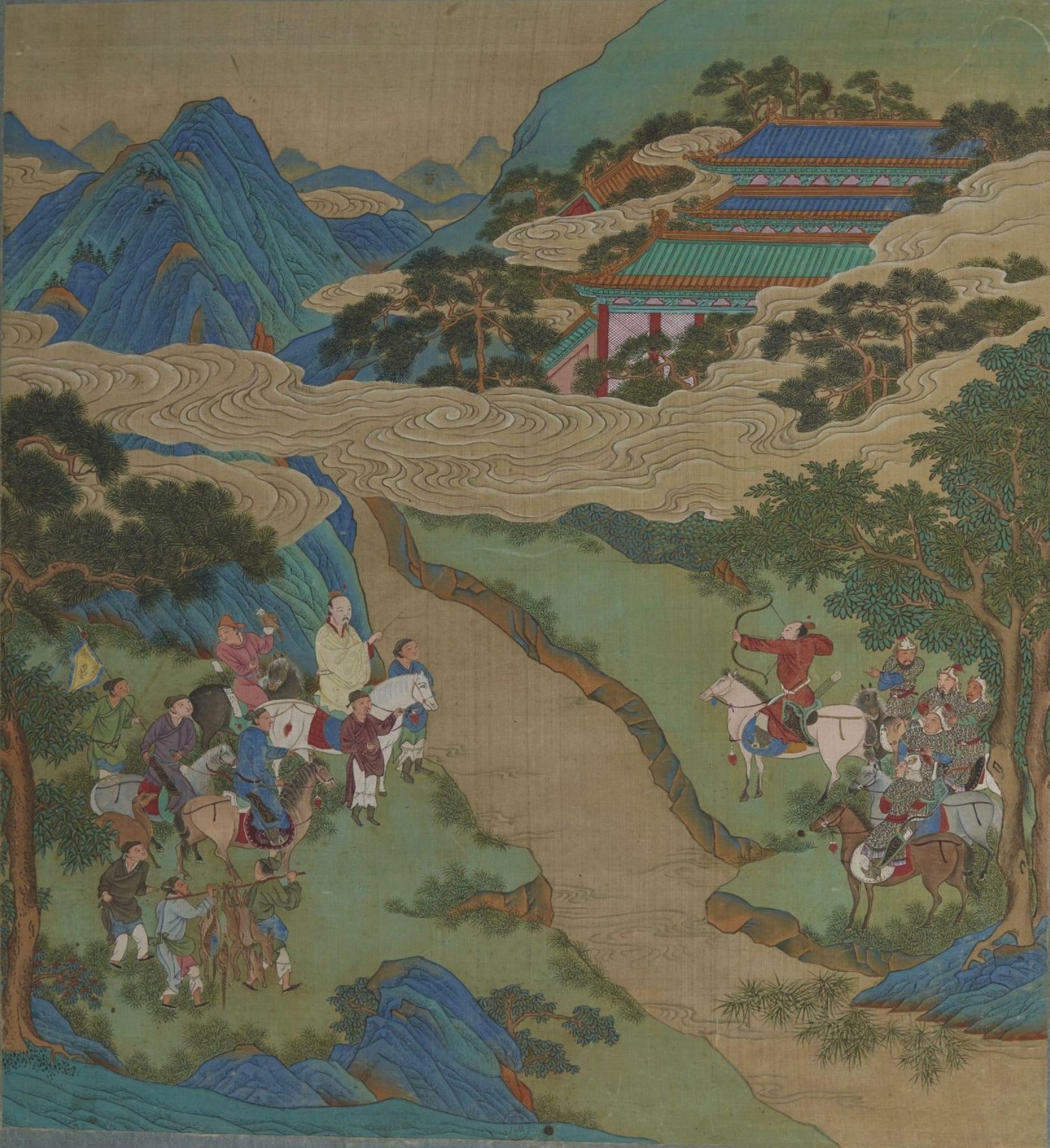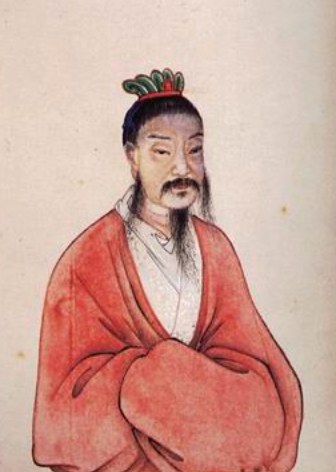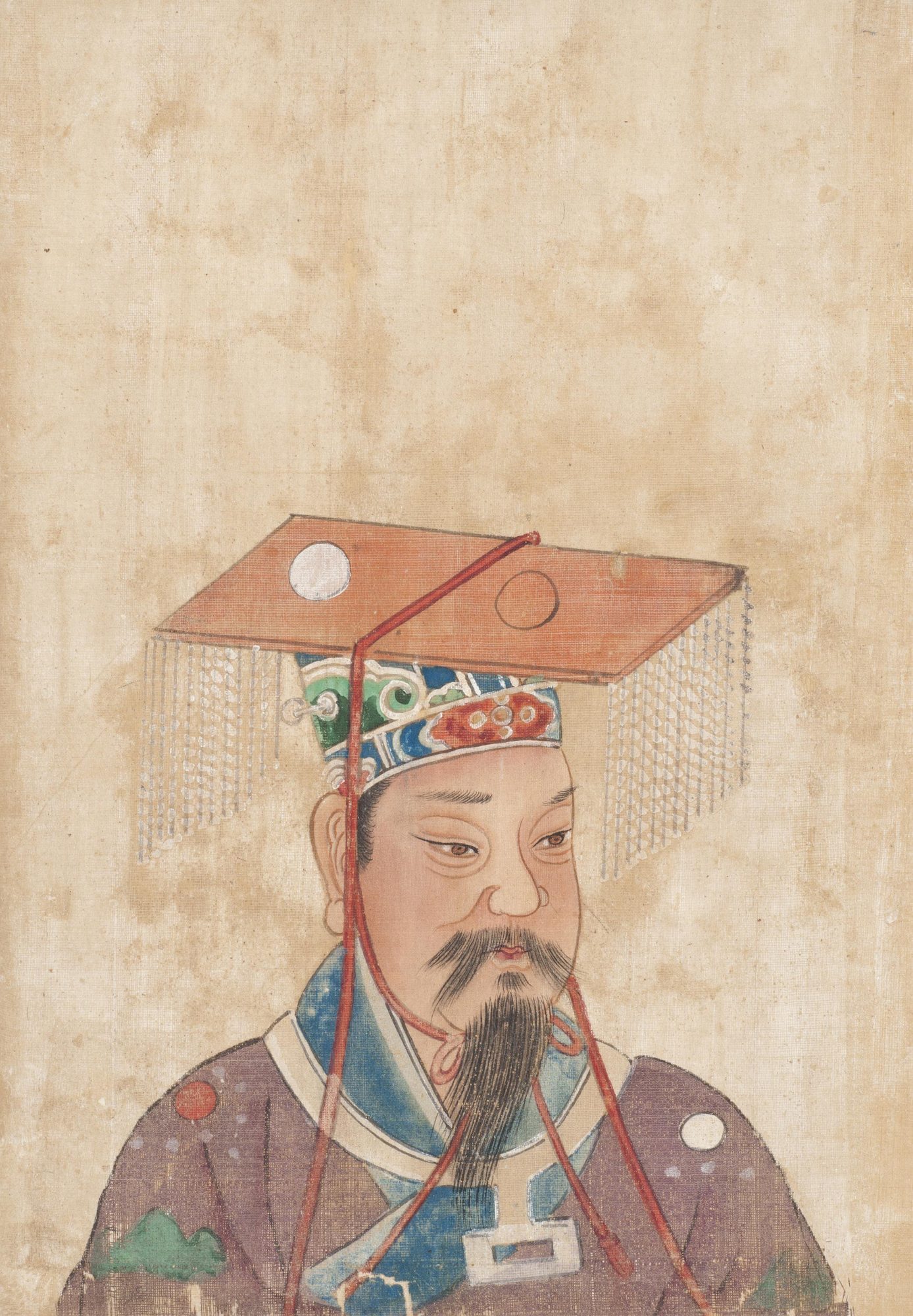
At the foot of Mount Jing the copper was already in the mould. The Yellow Emperor had mined the ore from Mount Shou and cast it into a single great cauldron, and on the day the casting was finished a dragon came down out of the sky with its long whiskers hanging, and it had come for him. He mounted its back, and more than seventy of his ministers and his women climbed up after him, and the dragon began to rise. The lesser officials who could not reach a place on it seized instead at the trailing whiskers; the whiskers tore out and fell, and the Emperor’s bow fell with them, and the people on the ground wept over the fallen bow. So a lake was afterward called Cauldron Lake for the vessel cast there, and a bow was called Wuhao, the Raven’s Wail, for the crying left behind.
This is how one strand of the tradition ends the founder of the Chinese world, with a departure rather than a grave. The man who vanished into the sky on a dragon and the man buried under a mound are the same Yellow Emperor, told by the same historian in the same century. The war against the storm-monster Chiyou that first raised him to the throne belongs to another telling. What is owed here is everything the sovereign was once the fighting was done: the conqueror who could not sit still, the ancestor of every emperor after him, and the god who kept slipping out of his own death.
Yellow for the power of Earth
The war left him a throne and no rest. In Sima Qian’s Records, the oldest connected account of him, the young lord of the Gongsun clan named XuanyuanThe Yellow Emperor's given name in the Shiji, of the Gongsun clan; also the mound and later the age with which he is identified. is a prodigy from the cradle: born numinous, able to speak while still an infant, quick and even-minded as a child. He is titled the Yellow Emperor not for anything about his face but for an omen. He received the sign of the power of Earth, and in the cosmology that governs all of this the colour of Earth is yellow and its place the centre, so the name sets him at the still point on which the four directions turn.
But he did not then enjoy the centre. The Records insists he never once dwelt at ease, cutting through mountains and opening roads, and it maps his restlessness as a survey of the world in four directions. East he reached the sea and climbed the sacred peaks; west he came to Kongtong; south to the Yangzi; north he drove out the border tribes and built his city on the slope of Zhuolu.
When the inside had to be ordered, he named all his offices with the word for cloud and made his marshals cloud-marshals, so that his whole administration read like a weather-map of the sky. The frame the Records gives that rule is frankly cosmic: he followed the ordering-threads of Heaven and earth, sowed the hundred grains in season, gentled the birds and beasts, and set in their courses the sun and moon and stars, the waters and the earth, stone and metal and jade. Rule, in this telling, is not the commanding of men. It is the alignment of the world.
Fourteen surnames and a grandson
The other thing the sovereign founded was a bloodline, and the bloodline, more than any conquest, made him the ancestor of imperial China. The Records counts him twenty-five sons, of whom fourteen took surnames, so that whole clans traced their names to him. His chief consort was a woman of the Xiling clan, Leizu, who bore two sons whose descendants would each in turn hold the world: Xuanxiao and Changyi.
(The famous story that Leizu discovered silk is a later tradition; the earliest account says nothing of it.) Changyi’s son Gaoyang succeeded as the Emperor Zhuanxu, so the line ran on through the grandson rather than the son. From the Yellow Emperor down through Zhuanxu and Ku to Yao and Shun and Yu, the Records says, all were of one surname though they took different dynastic titles.
That clean genealogy is itself a choice. Sima Qian admits in his afterword that the hundred schools’ talk of the Yellow Emperor was not decorous,
and that he kept the refined traditions and set the wild ones aside. The wild ones survive in the Classic of Mountains and Seas, where the descent is neither so clean nor so short.
It inserts an extra generation between Changyi and Zhuanxu, a being called Hanliu with a long-drawn head and close-set ears, a human face and a pig’s snout, a body like a deer, bandy legs and pig’s trotters for feet. It runs a second line down to Gun, father of the Yu who would fight the flood. The polished forefather of the annals and this monstrous ancestor of the myth-geography are one figure seen through two lenses, the texts only decades to a century apart in date but worlds apart in what they will let onto the page.
What the jade-grease was for
The mythic lens shows something else the annals will not: a Yellow Emperor already feeding on the stuff of immortality while still on the earth. In the Classic of Mountains and Seas the mountain called Mi runs with jade-grease, welling up and bubbling hot, and on this the Yellow Emperor feeds and feasts, then takes the jade-flower of the mountain and casts it on the sunlit south face of Mount Zhong to sow more jade. Kunlun, the same book says, is the God’s earthly capital.
It is a luminous image, a sovereign nourished on molten jade in a garden of the gods. A much later commentator, Guo Pu of the Jin dynasty, joined it straight to the departure at Cauldron Lake: this, he wrote, is how the Yellow Emperor came to mount the dragon and shed his mortal form. The jade-eating is in the ancient text; the link to the ascension is the commentator’s, written many centuries after, and the two should be held a little apart. But the pull is plain enough. The tradition wanted its founder already half-immortal.
The Son of Heaven on his knees
For all that, the strangest thing the Yellow Emperor does is kneel. The Zhuangzi sets the scene nineteen years into his reign, his commands running unopposed through the world, when he hears that the sage GuangchengziA Daoist immortal-sage of Mount Kongtong in the Zhuangzi who claims twelve hundred years of undecayed self-cultivation and teaches Huangdi the Way. lives atop Mount Kongtong and climbs up to ask him the essence of the Perfect Way, wanting to seize the finest of Heaven and earth to aid the harvests and nourish his people. The hermit rebuffs him flatly.
So the sovereign of the world does an extraordinary thing. He withdraws, casts off the empire, builds a solitary hut, spreads a mat of white cogon-grass and lives apart on it three months. Then he goes back up the mountain, and this time he does not ask how to feed his people. He goes forward on his knees, bows twice and touches his head to the ground, and asks only how to govern his own body so as to live long.
The answer is the seed of everything Daoism would later build on him: perfect stillness and perfect clarity, do not toil the body, do not agitate the vital essence, and you may live long. The teacher claims to have cultivated himself this way for twelve hundred years, his form never decaying. The war-god who broke the storm-monster ends, in this telling, crawling toward a recluse to learn how not to die.
The tomb with nothing in it
Which leaves the question the tradition never settled: did he die at all? Sima Qian answers it twice and does not reconcile the two. In the sober annals the Yellow Emperor dies and is buried at Mount Qiao, four plain characters, a mortal end. In the treatise on the great sacrifices, the same historian records the dragon at Cauldron Lake carrying him bodily into heaven, where he simply does not die.
The historian keeps the two in different registers on purpose. The burial is history-of-record. The ascension he presents openly as a fangshiA master of esoteric arts and recipes for deathlessness; the Shiji frames the dragon-ascension as such a man's tale told to Emperor Wu of Han.’s tale, put before Emperor Wu of Han by a courtier hungry for imperial patronage. Such men promised the living emperor that sacrifice could make him deathless, and such,
they said, was the Yellow Emperor.
The endings were only harmonised much later, when the Tang physician Wang Bing wrote that the ascension was real and that his ministers had buried at Mount Qiao only his robes and cap. The tomb on the mountain, in that reading, holds nothing but the clothes of a man who went to heaven.
That harmonising physician was editing a canon that bears the Emperor’s name, and it is the last of his afterlives, the clearest case of the tradition adopting him rather than remembering him. The Huangdi Neijing, foundational classic of Chinese medicine, is built entirely as a dialogue in which the Yellow Emperor questions his Celestial Teacher, QiboThe Celestial Teacher whose questions and answers with the Yellow Emperor frame the Huangdi Neijing medical canon; a persona of a Han-compiled text, not a court physician., and Qibo answers.
It is a Han compilation, attested under that name only from the Han onward by its own editors’ admission, and Wang Bing’s authoritative version is Tang, some two thousand years after any notional Yellow Emperor. He did not write it. He is its framing author, the sage under whose name later ages chose to place their knowledge, exactly as they placed deathlessness and a bloodline and the founding of the world under the same name. The owl and the broken mirror that Han officiants once sacrificed to him at the spring rite were offered to a god by then, not a king.
The Yellow Emperor mined copper from Mount Shou and cast a cauldron at the foot of Mount Jing. When the cauldron was finished, a dragon with drooping whiskers came down to welcome him. The Yellow Emperor mounted it; his ministers and harem who followed him up numbered more than seventy, and the dragon rose away. (Shiji, “Fengshan shu”; author’s rendering from the Chinese)
- Sima Qian (司馬遷), Shiji (史記),
Wudi benji
(五帝本紀, Annals of the Five Emperors), c. 100 BCE (Western Han): the founding-sovereign biography, read verbatim. The infant born numinous who could speak (生而神靈,弱而能言); the accession over the declining house of Shennong and the title from the omen of Earth-power (有土德之瑞,故號黃帝); the ceaseless road-building (披山通道,未嘗寧居) and the four-quarters progress to the sea, Kongtong, the Yangzi and the northern frontier, mustering the tally at Mount Fu and settling at Zhuolu (東至于海…西至于空桐…南至于江…北逐葷粥,合符釜山,而邑于涿鹿之阿); the cloud-named offices and cloud-marshals (官名皆以雲命,爲雲師) and the Grand Inspectors of left and right (置左右大監,監于萬國); the precious tripod-cauldron and the reckoning of days by divining-stalks (獲寶鼎,迎日推筴); the cosmic-order rulership (順天地之紀…旁羅日月星辰水波土石金玉); the four ministers Fenghou, Limu, Changxian and Dahong (舉風后、力牧、常先、大鴻以治民); the twenty-five sons of whom fourteen took surnames (黃帝二十五子,其得姓者十四人); the marriage to Leizu of Xiling and the sons Xuanxiao (Qingyang) and Changyi (娶於西陵之女,是爲嫘祖…生二子…玄囂…昌意); the death and burial at Mount Qiao and the succession by the grandson Gaoyang, the Emperor Zhuanxu (黃帝崩,葬橋山,其孫昌意之子高陽立,是爲帝顓頊); and the single-surnamed line from Huangdi to Shun and Yu (自黃帝至舜、禹,皆同姓而異其國號). Chinese read verbatim (zh.wikisource.org, page 史記/卷001). For a citable English sentence, quote a named translation (e.g. Nienhauser, ed., The Grand Scribe’s Records, vol. 1) and re-verify; the wording above is the author’s own literal rendering from the Chinese. - Sima Qian (司馬遷), Shiji (史記),
Fengshan shu
(封禪書, Treatise on the Feng and Shan Sacrifices), c. 100 BCE: the ascended-immortal strand, framed by Sima Qian NOT as annal but as a fangshi (magician’s) legend the courtier Gongsun Qing laid before Emperor Wu of Han. The Dinghu dragon-ascension in fullcopper mined from Mount Shou, a cauldron cast at the foot of Mount Jing, a whiskered dragon descending, more than seventy ministers and consorts mounting, the lesser men seizing the whiskers until whiskers and bow tore loose and fell, and the naming of the place Dinghu (Cauldron Lake) and the bow Wuhao (黃帝采首山銅,鑄鼎於荊山下…龍髯拔,墮,墮黃帝之弓…名其處曰鼎湖,其弓曰烏號); the twenty reckonings over three hundred and eighty years before the ascension (凡二十推,三百八十年,黃帝僊登于天); the three treasure-cauldrons modelling Heaven, Earth and Man (黃帝作寶鼎三,象天地人); Huangdi as the paradigm ruler made deathless by feng-shan sacrifice (見之以封禪則不死,黃帝是也) and the only one of the seventy-two feng-shan kings permitted to feng on Mount Tai (封禪七十二王,唯黃帝得上泰山封); and the Han state-cult offering to Huangdi of one owl and a broken mirror (祠黃帝用一梟破鏡). Chinese read verbatim (zh.wikisource.org, page 史記/卷028). - Zhuangzi (莊子),
Zaiyou
(在宥), Warring States, 4th–3rd c. BCE (Outer Chapters, with later Han strata): the Daoist-seeker strand, read verbatim. Nineteen years enthroned with his commands running through the world, Huangdi climbs Mount Kongtong (空同) to beg the Perfect Way of the hermit Guangchengzi (黃帝立爲天子十九年,令行天下,聞廣成子在於空同之上,故往見之); rebuffed, he casts off the empire, builds a solitary hut, spreads a mat of white cogon-grass and lives apart three months (黃帝退,捐天下,築特室,席白茅,閒居三月); returns and goes forward on his knees, bowing twice with his head to the ground (膝行而進,再拜稽首), asking now only how to govern his own body for long life; and receives the quietist teaching, Guangchengzi claiming twelve hundred years of undecayed cultivation (必靜必清,无勞汝形,无摇汝精…故我脩身千二百歲矣,吾形未常衰). Chinese read verbatim (zh.wikisource.org, page 莊子/在宥). - Shanhaijing (山海經),
Hainei jing
(海內經) andXishan jing
(西山經), Warring States–Han strata: the mythic Huangdi, the material Sima Qian pruned asnot decorous
(不雅馴). The alternate descent through Hanliu (韓流), who has a long-drawn head and close ears, a human face and a pig’s snout, a qilin-like body, bandy legs and pig’s trotters, inserted as an extra generation between Changyi and Zhuanxu (黃帝妻嫘祖,生昌意…生韓流…擢首、謹耳、人面、豕喙、麟身、渠股、豚止…生帝顓頊), so that Zhuanxu is here his great-grandson, not his grandson as in the Shijithe descent lines disagree and are flagged, not smoothed. The second line Huangdi → Luoming → Baima, who was Gun (黃帝生駱明,駱明生白馬,白馬是為鯀). Kunlun as the God’s earthly capital (帝之下都), and the jade-grease of Mount Mi welling up bubbling hot, on which the Yellow Emperor feeds and feasts before sowing its jade-flower on the sunlit south of Mount Zhong (是有玉膏…黃帝是食是饗…取峚山之玉榮而投之鍾山之陽). The dragon-shedding link to the Dinghu ascension (所以得登龍於鼎湖,而龍蛻也) is Guo Pu’s (郭璞) Jin-dynasty commentary, labelled as such and not base text. Chinese read verbatim (zh.wikisource.org, pages 山海經/海內經, 山海經/西山經). For a citable English sentence, quote a named translation (e.g. Birrell, The Classic of Mountains and Seas, Penguin) and re-verify; the wording above is the author’s own literal rendering. - Huangdi Neijing (黃帝內經), Suwen (素問),
Shanggu tianzhen lun
(上古天真論), Han compilation, Wang Bing (王冰) recension 762 CE (Tang): the attribution tradition, NOT authorship. The canon is framed throughout as the Yellow Emperor’s dialogue with the Celestial Teacher Qibo (岐伯), and opensIn antiquity there was the Yellow Emperor, born divinely numinous… and in maturity ascended to heaven
(昔在黃帝…成而登天). Wang Bing’s note supplies the empty-robe-tomb harmonisationthe cauldron cast at Dinghu, the ascension in broad day, the ministers burying only his robes and cap at Mount Qiao (鑄鼎於鼎湖山,鼎成而白日升天,羣臣葬衣冠於橋山). The text’s own editorial apparatus admits the name Suwen is attested only from the Han onward, so Huangdi is a framing author, not the historical compiler; the attribution is the tradition, not authorship. Chinese read verbatim (zh.wikisource.org, page 黄帝内經素問 (四庫全書本)/卷01).