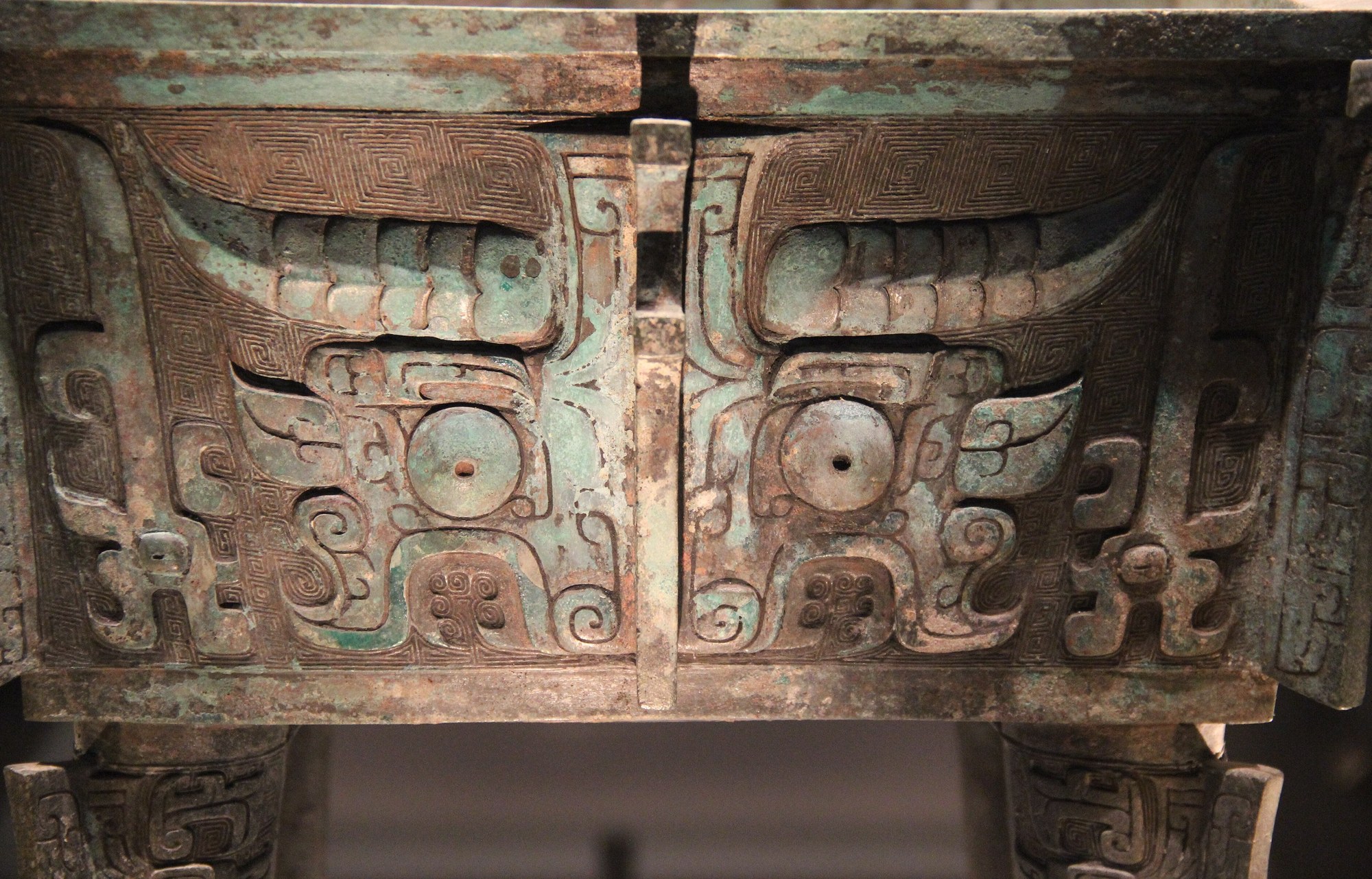
The bronze face on the old cauldron is all appetite. Two great eyes, a pair of horns or ears curling up from the brow, and beneath them a mouth wide enough to swallow the vessel it decorates. There is no body. In the oldest description that names it, the creature is precisely that and nothing more: a head with no trunk, no belly, no gut to fill, and yet forever eating. It bites down on a man, and before the mouthful can even reach the throat, the harm turns and rebounds on the biter. Gluttony so total it cannot swallow, greed so complete it consumes the greedy. The name the Chinese gave this maw is Taotie, and the word itself, doubled, is still the ordinary word for a glutton today.
But the face and the name did not begin together, and the honest place to start is with how far apart they are.
A mask the bronze-casters never named
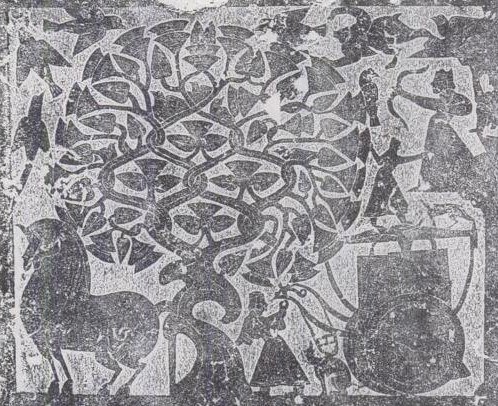
The mask comes first, by a very long way. It stares out from the ritual bronzes of the Shang and early Zhou, cast between roughly 1600 and 771 BCE, symmetrical and frontal, the single most persistent motif in the whole vast repertoire of early Chinese bronze design. No inscription on any of those vessels calls it Taotie. The craftsmen who cut the moulds left no name for the thing they were casting so obsessively.
The earliest surviving text to write the graph 饕餮 at all is the Zuo Zhuan, compiled around the fourth century BCE, more than a thousand years after the earliest of those masks were poured. And the text that actually fastens the name onto the bronzes, the Lüshi Chunqiu, is later still, from about 239 BCE, centuries after even the last Zhou cauldrons it describes.
So when a museum label reads taotie mask,
it is applying a Warring States word to a Bronze Age object across a gap of up to a millennium. The identification of the ancient animal-face motif with the Lüshi Chunqiu’s taotie is itself a much later scholarly inference, argued by Song antiquarians and refined by modern archaeology, which often prefers the neutral term animal mask
precisely because the ancient bronze-casters never told us what they called it.
The head that eats itself
The passage that gives the monster its meaning is a single sentence, and it is one of the strangest images in the Chinese record. Writing on the eve of the empire, the compilers of Mr Lü’s compendium reach back to the great dingAn ancient Chinese ritual bronze cauldron, three- or four-legged, cast for offerings and, as here, bearing didactic ornament.-cauldrons of the vanished Zhou and report what was cast on them:
The Zhou ding-cauldrons were emblazoned with the taotie: it has a head but no body; it devours a man, but before it can swallow him the harm reaches its own body. This is a way of speaking about retribution. (Lüshi Chunqiu, “Xianshi”; author’s rendering from the Chinese)
Everything the figure means is packed into that paradox. A mouth without a stomach cannot be fed; appetite with no body to nourish is appetite that can only turn on itself. The text is explicit that this is not natural history but a warning, cast into metal on purpose. The ancient rulers, the passage says in its wider argument about foresight, set this devouring face on their most sacred vessels as a memento against greed, so that the harm of insatiable wanting is shown rebounding on the one who wants. The glutton is not punished by some outside hand. He is destroyed by the very act of consuming.
The greedy son at the four gates
There is a second Taotie, and the sources keep the two apart. In the Zuo Zhuan, and again in the Shiji some two to three centuries afterwards, Taotie is not a face on a cauldron but a man, one of the Four FiendsThe 四凶, four wicked clan-sons of the sage-age whom the sage-emperor Shun is said to have banished to the wild frontiers; Taotie is one., the four wicked clan-sons banished in the golden age.
Here the name is a verdict passed on a human being. Taotie is the untalented son of the Jinyun clan, and his crime is drawn as pure consumption: greedy for food and drink, reckless after goods and bribes, his craving heaping up extravagance until nothing could satisfy him, hoarding and amassing without limit, giving nothing to the orphaned and the widowed, showing no pity to the poor and the destitute.
The people, ranking him with three other monstrous clan-sons, called him Taotie, the glutton. Serving under the emperor Yao, the sage Shun received the guests at the four gates and cast the four fiend-clans out to the wild frontiers of the world, to stand guard there against the goblin-demons of the hills and marshes.
Sima Qian, writing around 91 BCE, tells the same story in fewer words, and even the small differences are instructive: the two accounts spell some of the other fiends’ names slightly differently, the ordinary drift of two texts two or three centuries apart copying one tradition.
What the two Taoties do not share
It is tempting to weld the two together into a single career, the banished glutton who ends up graven on the cauldrons. The sources do not let us. The Zuo Zhuan and the Shiji give a human villain with no physical form, no cauldron, no head-without-body. The Lüshi Chunqiu gives the devouring face and its moral, and never once mentions the Four Fiends, or Shun, or the Jinyun clan. Neither of the two traditions reaches across to the other. The equation the banished glutton is the face on the bronzes
is a later synthesis, natural enough given the shared idea of bottomless greed, but it is stitched by readers, not stated by any of these texts.
What the two share is only the appetite, and the judgement laid on it. In both lives Taotie is the name a culture gives to wanting without limit and then condemns: the emblem cast into ritual bronze so the harm of greed is shown rebounding on the greedy, and the verdict pronounced on the man who took everything and gave nothing back. The monster is the moral. It was never anything else.
- 春秋左氏傳 (Zuo Zhuan / Zuo Commentary on the Spring and Autumn Annals), Duke Wen year 18 (文公十八年), text compiled c. 4th c. BCE (scene set 609 BCE): the earliest surviving text to name 饕餮; the Four Fiends (四凶) narrative; the full charge-sheet of Taotie’s insatiable greed (「貪于飲食,冒于貨賄…不可盈厭…不分孤寡,不恤窮匱」); Taotie as the untalented son of the 縉雲氏 Jinyun clan; and Shun’s banishment of the four fiend-clans to the four wild frontiers (四裔) to ward off the 螭魅 hill-and-forest demons. Chinese read verbatim; English is the author’s literal gloss.
- 史記 (Shiji / Records of the Grand Historian), Sima Qian, 五帝本紀 (Basic Annals of the Five Emperors), c. 91 BCE (Western Han): the compressed parallel within Shun’s annals (「縉雲氏有不才子,貪于飲食,冒于貨賄,天下謂之饕餮。天下惡之,比之三凶」; 「流四凶族,遷于四裔,以御螭魅」), a near-verbatim descendant of the Zuo Zhuan passage some 200–300 years later; minor orthographic variants in the other fiends’ names.
- 呂氏春秋 (Lüshi Chunqiu / Mr Lü’s Spring and Autumn Annals), 先識覽·先識 (
Xianshi
), c. 239 BCE (compiled under Lü Buwei): the single passage tying the name 饕餮 to the Zhou ritual bronzes and giving its defining paradox (「周鼎著饕餮,有首無身,食人未咽,害及其身,以言報更也」), framed as a moral emblem of retribution (報更), not zoology; the variant note that 未 (before swallowing
) is written 來 in some editions, the received reading 未 yielding the paradox. - 說文解字 (Shuowen Jiezi), Xu Shen, c. 100 CE (Eastern Han): the lexical gloss 饕,貪也 (
tao = greed / gluttony
), etymological support for the name.