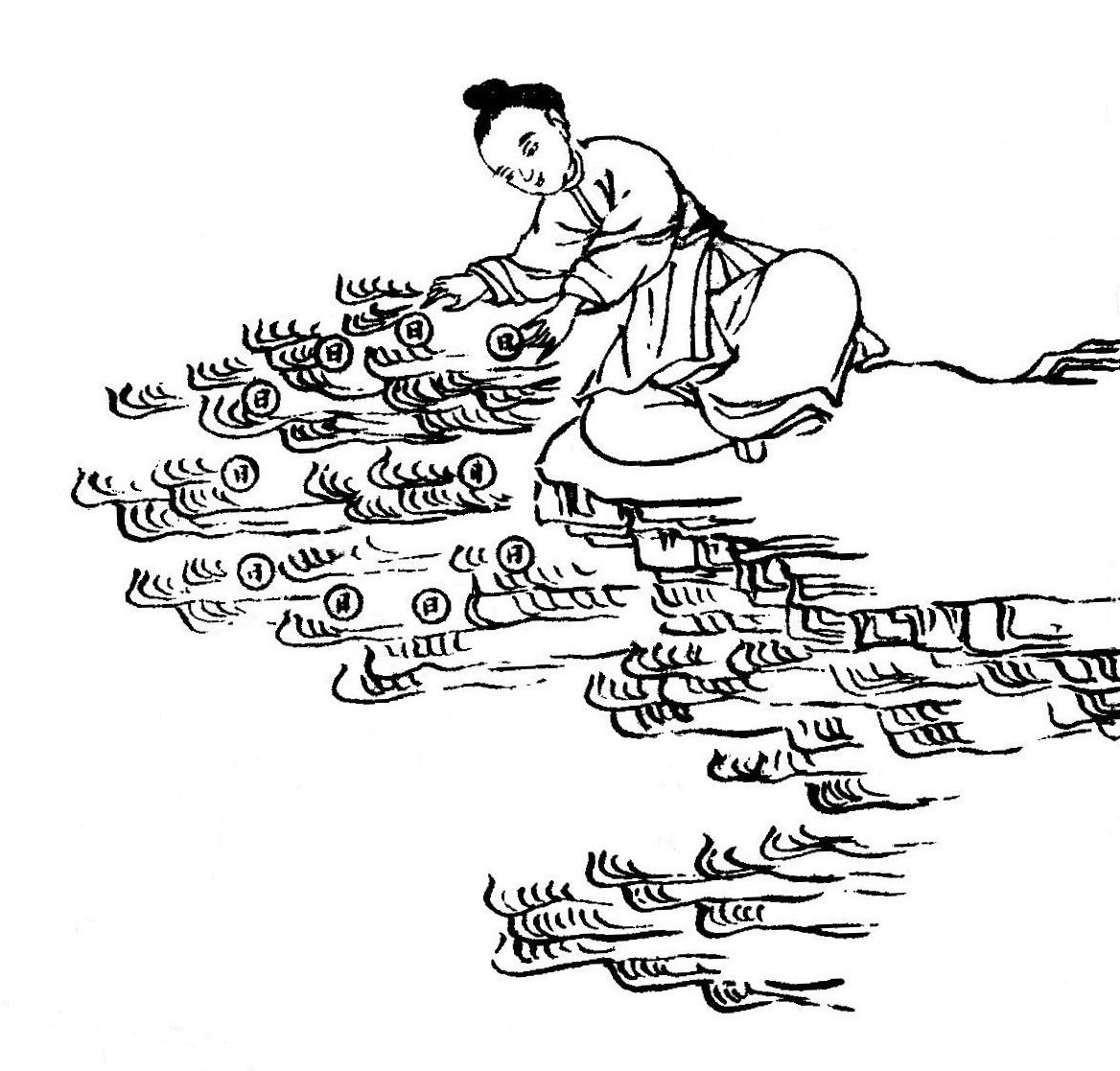
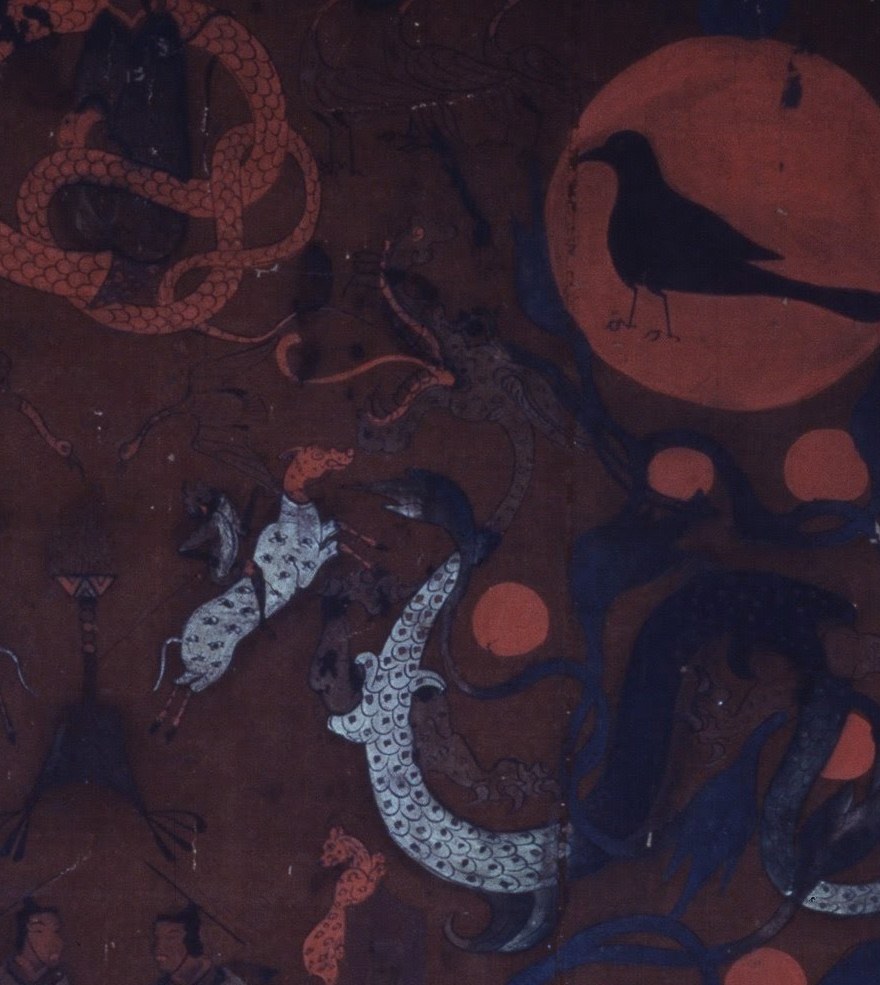
Far in the east, past the last of the seas, the water boils. There is a valley there where the sea runs hot, all steam and rising heat at the rim of the world, and out of that scalding water grows a tree. It is a mulberry, and it is colossal, and it does not belong to any forest a person could walk into. This is the Fusang, and in its branches live the suns. Not the sun. The suns: ten of them, nine perched on the lower boughs and one alone on the topmost branch, waiting. Each dawn the one on top goes out to cross the sky, and each evening it comes home to the tree, and the next morning another takes the highest branch and its turn. That is how the oldest Chinese account of the heavens keeps the days in order, one sun at a time out of a tree of ten.
A painter’s brief, not a story
The book that says so is the Classic of Mountains and Seas, a strange gazetteer of the edges of the earth, and it is spare and exact about the place. Below is the Boiling Valley; above the Boiling Valley grows the Fusang, where the ten suns bathe. The great tree stands in the water. Nine suns on the lower branches, one on the upper.
It is almost a painter’s brief rather than a story: a hot valley, a tree rooted in the sea, and ten burning things roosting in it like birds, arranged with a precision that tells you the whole cosmic order hangs on the arrangement. Only one sun is ever meant to be aloft. The other nine wait their turn in the leaves.
Borne across the day on black wings
A second passage in the same book gives the tree a different name and a scale that is hard to hold in the mind. There it is written Fumu, the support-tree, and the old commentators Guo Pu and Yuan Ke read it as the same tree under another brush-stroke. It rises over a valley of warm water, the same eastern place, and it is a pillar three hundred li tall with leaves like mustard-leaves.
Set those two details against each other and the image turns vertiginous: a trunk that climbs for a hundred miles into the sky, and hanging off it, foliage no bigger than the leaf of a garden herb. This is the second passage that gives the mechanism its clearest words. As one sun arrives, one sun departs, and each is carried by a crow. The suns do not simply hang in the tree and shine. They are borne across the day on black wings, one going out as one comes back, passing each other at the great mulberry that is both their roost and the gate of morning.
The extra leg came later
So the sun of these texts is not a bare disc of fire. It is a bird, or it rides one. The idea runs deep in early Chinese cosmology: the Huainanzi, the great Han compendium of the second century BCE, says plainly that within the sun there is a crouching crow. That is worth being careful about, because the picture most people carry is of a three-legged crow in the sun, and that specific bird belongs to a later age, to Han tomb reliefs and the apocryphal weft-texts, not to these early lines.
The oldest sources give a crow, crouching inside the light or carrying it aloft, and leave the extra leg to the centuries that followed. What the crow does is constant: it makes the sun a living thing that comes and goes, roosts and wakes, rather than a lamp hauled on a fixed track.
Xihe at the Sweet Gulf
The tree also has a keeper, and she gives the ten suns a mother. Beyond the eastern sea, among sweet waters, the same book sets a woman named Xihe, wife of the high god Di Jun, and it says she bore the ten suns and bathes them in a place called the Sweet Gulf. It is a domestic image at a cosmic scale, a mother washing her children before they go out, except that the children are the daylight and the washbasin is a gulf at the edge of the world.
The passage surfaces twice, once placed in the south and once in the east, and the old editor Yuan Ke judged the eastern placement the true one, since the Sweet Gulf and the Boiling Valley of the sunrise belong together in the east. Xihe, the tree, the valley, the crows: these are the furniture of the sunrise, assembled at one spot on the rim of the world.
Sixteen waystations across the sky
What happens after the sun leaves the tree is charted, litany-like, in the Huainanzi, and here the cosmos becomes an itinerary. The sun rises from the Valley of Dawn, bathes in the Pool of Xian, brushes past the Fusang and then mounts it to begin the journey. From there it runs a fixed road of named stations across the sky: past the bend of Quë, over the Mulberry Wilds, through noon at Kunwu, down into the Valley of Grief, until at last it reaches the Abyss of Yu at dusk and the Vale of Obscurity at nightfall. It is a day mapped as a route with sixteen waystations, the sky turned into a country with places in it.
One honest seam shows here, and the texts do not hide it. In this systematised Han version the sun is drawn not by a crow but by a chariot, with horses and a female driver who, near the day’s end, halts the team at the Spring of Grief (悲泉, a station distinct from the earlier Valley of Grief) and hangs up the carriage for the night. The crow of the eastern gazetteer and the horse-chariot of the Han treatise are two different vehicles from two different systems, laid over the same sun. The tree, at least, is the fixed point both traditions share: the launch of the day is always the Fusang.
There is a matching tree at the other end of the road. Where the Fusang stands at the sunrise, the western sky has the Ruo, and the southern poems of the Chuci picture a traveller breaking off a branch of the Ruo to brush the sinking sun, and watering the sun-horses at the Pool of Xian and tying the reins fast at the Fusang. Sunrise tree and sunset tree, one in the boiling east and one in the west, book-end the daily crossing. The mulberry is where the day begins; the Ruo is where it is let go.
The day the tree emptied
And then there is the day the tree emptied all at once. The order these texts are so careful about, nine waiting while one works, is a fragile thing, and the Huainanzi remembers when it broke. In the reign of the sage-emperor Yao, the ten suns came out together, all ten of them climbing into the sky at once, and the crops charred where they stood and the plants died and the people had nothing left to eat. That is the catastrophe the orderly tree is built against, and its remedy is another story, told elsewhere: Yao sends the archer Yi, who shoots at the ten suns overhead.
The received text says only that he shot at them and does not count how many fell; the tidy tally of nine downed and one spared is a later age finishing the sentence. What matters for the tree is the contrast. The normal state of the heavens is one sun out of ten, taking its turn from the topmost branch. The disaster is all ten leaving the branches together. The whole quiet architecture of the Fusang, nine roosting and one aloft, exists to say that the sky is only safe when the suns keep their order and wait their turn in the tree.
Below is the Boiling Valley. Above the Boiling Valley grows the Fusang, where the ten suns bathe; nine suns roost on the lower branches, and one sun on the upper branch. (Shanhaijing, “Haiwai dong jing”; author’s rendering from the Chinese)
- **Shanhaijing (山海經), Haiwai dong jing (海外東經), Beyond the SeasEast:** below lies the Boiling Valley (Tanggu, 湯谷), and above it grows the Fusang (扶桑) where the ten suns bathe (十日所浴); the great tree stands in the water (居水中,有大木), with nine suns on the lower branches and one on the upper (九日居下枝,一日居上枝). The load-bearing image of the roosting suns. Chinese read verbatim (zh.wikisource); English renderings here are the author’s own working glosses of the verified original, not a published translation.
- **Shanhaijing (山海經), Dahuang dong jing (大荒東經), Great WildsEast:** the same eastern tree written Fumu (扶木),
a pillar three hundred li tall, its leaves like mustard
(柱三百里,其葉如芥), over the Warm-Source Valley (Wenyuan-gu, 溫源谷), identified with the Boiling Valley; the rotation of the suns,as one arrives, one departs, each borne by a crow
(一日方至,一日方出,皆載于烏); and, near the Sweet Gulf (甘淵), Xihe (羲和), wife of Di Jun (帝俊), who bore the ten suns (是生十日). Guo Pu (郭璞) and Yuan Ke (袁珂) treat Fumu and Fusang as one tree; Yuan Ke’s collation places the Xihe passage in the East. Chinese read verbatim (zh.wikisource); English glosses the author’s own. - **Shanhaijing (山海經), Dahuang nan jing (大荒南經), Great WildsSouth:** Xihe, wife of Di Jun and mother of the ten suns, bathing the suns in the Sweet Gulf (方浴日于甘淵…生十日) — a near-duplicate of the East passage, which Yuan Ke’s (袁珂) collation argues belongs properly in the East. Chinese read verbatim (zh.wikisource); English glosses the author’s own.
- Huainanzi (淮南子), Tianwen xun (天文訓, Treatise on the Patterns of Heaven), c. 139 BCE: the sun’s daily itinerary — it rises from the Valley of Dawn (Yanggu, 暘谷), bathes in the Pool of Xian (咸池), brushes past the Fusang (拂于扶桑), then mounts it to begin its journey (登于扶桑,爰始將行), running through sixteen named waystations, among them the Valley of Grief (悲谷) before noon’s descent and the later Spring of Grief (悲泉), where the driver halts the horses and hangs up the chariot (縣車), on to the Abyss of Yu (虞淵) at dusk and the Vale of Obscurity (蒙谷) at nightfall. Notethis systematised Han version drives the sun by a female charioteer and horses (爰止其女,爰息其馬), not the crow of the Shanhaijing. Chinese read verbatim (zh.wikisource); English glosses the author’s own.
- Huainanzi (淮南子), Benjing xun (本經訓): in the reign of Yao (堯) the ten suns rise together, scorching the crops and killing the plants, so the people have nothing to eat (十日並出,焦禾稼,殺草木,而民無所食), and Yao sends the archer Yi (羿) to shoot at the ten suns above (上射十日). The received text says only that he shot at the ten and gives no number felled. Chinese read verbatim (zh.wikisource); English glosses the author’s own.
- Huainanzi (淮南子), Jingshen xun (精神訓, Treatise on the Quintessential Spirit):
within the sun there is a crouching crow
(日中有踆烏), the sun-crow of Han cosmology. The specifically three-legged crow (三足烏) is a later development in Han apocrypha and tomb iconography and is not in this passage or in the Shanhaijing’sborne by a crow
(載于烏). Chinese read verbatim (zh.wikisource); English glosses the author’s own. - Chuci (楚辭), Li Sao (離騷) and Tian Wen (天問), c. 3rd c. BCE onward: the sun-horses watered at the Pool of Xian and the reins tied at the Fusang (飲余馬於咸池兮,總余轡乎扶桑); and the western counterpart tree, the Ruo (若木), whose branch is broken to brush the sun (折若木以拂日) at the sunset end. Chinese read verbatim (zh.wikisource); English glosses the author’s own.