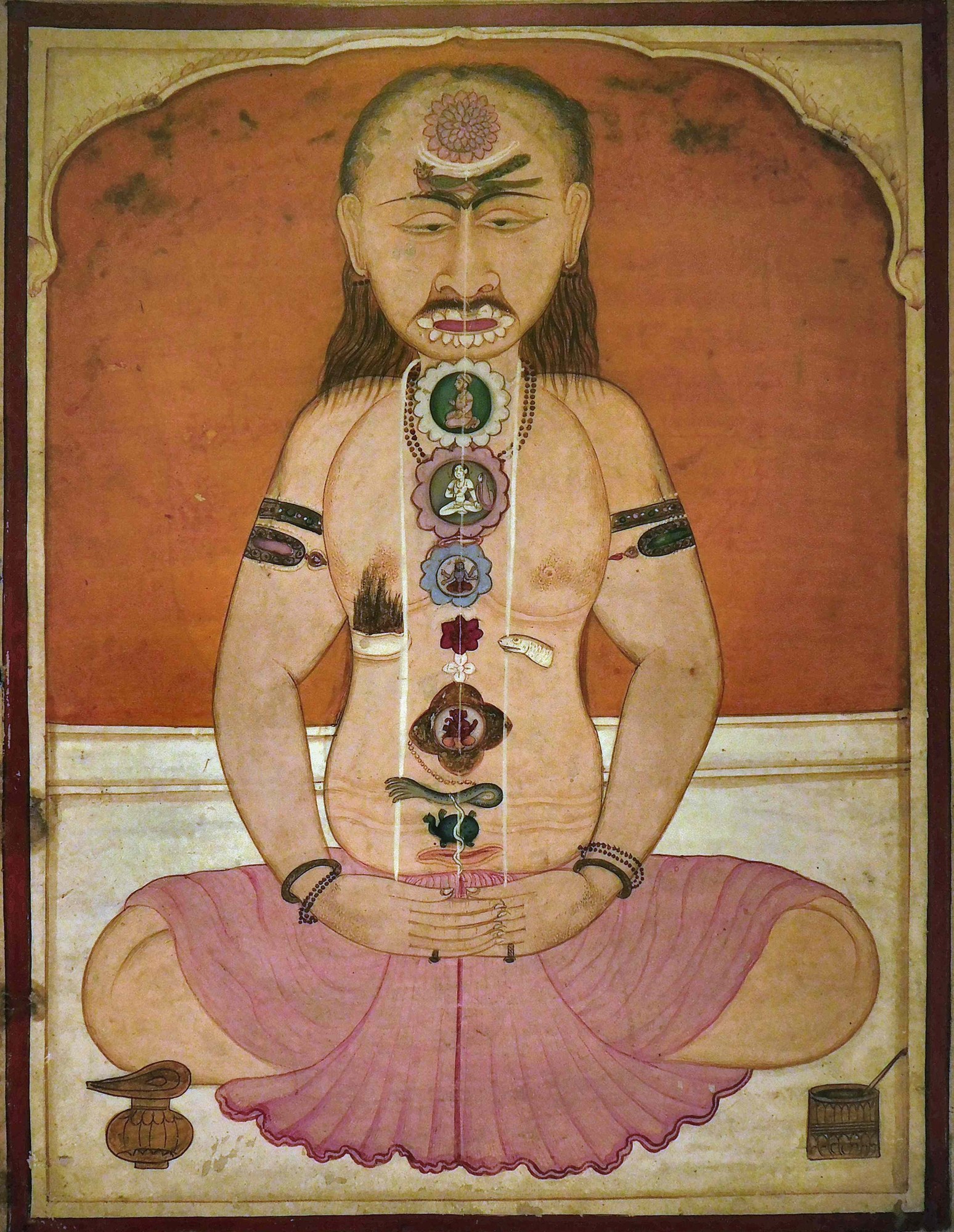
Climb as high as the cosmos will let you and you still have not escaped it. This is the vertigo the old texts want you to feel first. Reach the topmost heaven, the world of the creator himself, and your stay there is only long, not endless; when the reward you earned runs out, you fall back into a womb and are born again. Every station in the universe, however luminous, is a room with a return ticket stapled to the door. What the tradition calls redeathA rendering of punar-mrityu, 'dying again': the ancient fear that death itself repeats, so that even a heaven only defers the next death rather than ending it. is the horror underneath the whole scheme: not that you die once, but that death is a thing you keep doing, heaven after heaven, until something breaks the loop.
So the question the earliest strata put is not how to be rewarded. It is how to get out of samsaraThe round of birth, death and rebirth that liberation exits; in the Katha commentator's gloss, the condition of one who does not yet know the highest Brahman and so keeps migrating., the turning round of birth and death and birth again. Liberation is defined here almost entirely by a negation, by what stops happening. The freed one, in the phrasing the Katha commentator uses, becomes Brahman at once and migrates no more. Migrates no more: the whole weight of the idea sits on that. Everything else in the cosmos is in transit. This one thing has arrived.
When wanting stops
The Katha Upanishad, a verse text of the middle centuries before the common era, places the turn from mortal to immortal at a precise and startling point. Not at death. Not in some later heaven. Here, in the living body, at the moment desire falls silent. When all desires that dwell in his heart cease, the text says, then the mortal becomes immortal, and obtains Brahman.
That is worth reading slowly, because it inverts what the word liberation usually smuggles in. This is not a prize handed over at the end of a well-lived life. It is a change of state that happens the instant wanting lets go, and it happens, in the Katha’s own words, here on earth. The ties are severed while the man still walks about. Much later philosophers would give this in-life release a technical name, but that name is not in the Upanishad — only the plain claim that the immortal condition is not somewhere you go but something you become when the grasping stops.
The mechanism, such as it is, is desire and nothing else. The texts on rebirth make attachment the engine that drives the wheel: the deed binds because you cling to its fruit, and clinging carries you back into another birth to collect. Cut the clinging and the drive-shaft is disconnected. The wheel may keep its shape, but it no longer has anything to turn against you. Immortality in this reading is not a substance added to a person. It is a subtraction, the removal of the one appetite that kept the machine of return in motion.
The one artery of a hundred and one
The Katha then gives the exit a body, and the image is unforgettable in its physical specificity. There are, it says, a hundred and one arteries of the heart. A hundred of them run out in every direction; these are the ordinary channels, and by them a man at his death departs into this or that further birth, off along one more spoke of the wheel. But one artery, and only one, runs straight up and penetrates the crown of the head. Moving upwards by it, the text says, a man reaches the Immortal.
One channel out of a hundred and one. The proportion is the teaching. The overwhelming likelihood, structurally built into the very anatomy of the heart, is that you leave by one of the hundred and are poured back into the world. The single upward artery is the needle’s eye, the lone route that does not loop. It is a startlingly concrete picture of a wholly abstract claim: that of all the ways a self can leave a body, all but one lead back in again.
A light that needs no sun
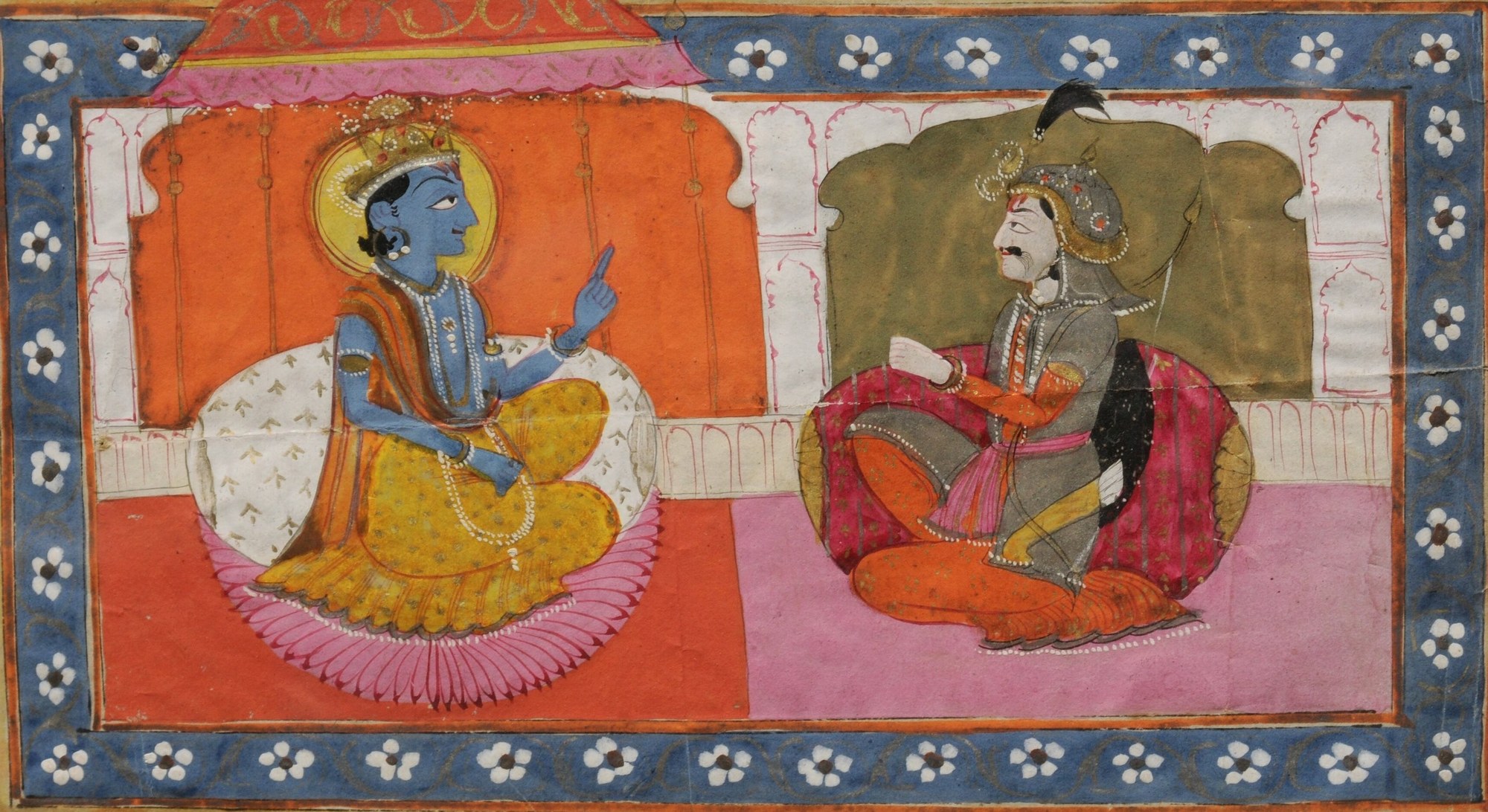
When the tradition moved into its theistic register, centuries after the Katha and the Mundaka were composed, it kept the logic of non-return exactly but changed where the door led. The Bhagavad Gita, whose layer is commonly dated two to five centuries after those Upanishads, no longer speaks of becoming an impersonal Brahman. It speaks of reaching a person. Having attained Me, Krishna says, the great souls are no more subject to rebirth in this world, which is transient and full of misery.
The Gita then draws the contrast the whole idea depends on, and draws it as a warning about heavens. Up to the highest abode of the creator Brahma, it says, all the worlds are places from which you will be born again; only on reaching Krishna’s own abode is there no further rebirth. This is the point that a modern picture of the afterlife tends to lose. A heaven, in this scheme, is not the goal. A heaven is a long and pleasant stretch still inside the round, expressly contrasted with the exit. To mistake the highest heaven for liberation is to mistake the best room in the house for the door out of it.
And that abode, the param dhamaThe 'supreme abode' of Gita 15.6: self-luminous, lit by no sun or fire, and the one place from which, the verse says, the self does not return., is described by what cannot reach it. Neither the sun nor the moon nor fire can illumine that supreme abode of mine, the Gita says; it shines by itself, needing no light from outside. Having gone there, one does not return. The self-luminous is precisely the thing that is not borrowing its light, and so not dependent, and so not subject to the running-down that sends every borrowed thing back to be renewed. The place from which none return is the one place that is not living on loan.
The river and the person
There is a genuine fault line running through all of this, and the honest reader has to keep it open rather than smoothing it flat. The two great images of what lies past the door are not the same picture. The older Mundaka Upanishad gives dissolution: as the flowing rivers disappear in the sea, losing their name and their form, so the wise, freed from name and form, go to the divine Person greater than the great. A river reaching the sea does not arrive as a guest. It ceases to be a river at all. There is no drop left over to say it has come home.
The Gita, several hundred years younger, gives arrival and abiding instead. Its great souls reach Krishna and remain his; the language is of attaining a Person and dwelling with him, which needs a self left over to do the dwelling. Set the river losing its name beside having attained Me and you are looking across a gap of centuries and across a real difference: extinction of the separate self on one side, eternal nearness to a personal God on the other.
These became the dividing line between the non-dualist and the theistic schools of Vedanta, and they are still arguing. What survives the exit, if anything does, is the one question the sources will not answer with one voice, and a retelling that pretended otherwise would be inventing an agreement the texts never reached.
What they do agree on is the condition of the one who is freed, and the Mundaka states it in three plain strokes. He who knows that highest Brahman becomes Brahman. Free from the fetters of the heart, he becomes immortal. He overcomes grief, he overcomes evil. Whether that freedom is a drop rejoining the ocean or a soul come at last into the presence of its Lord, both traditions describe the same near shore of it: the loosening of the knot in the chest, the end of grief, the stop.
As the flowing rivers disappear in the sea, losing their name and their form, thus a wise man, freed from name and form, goes to the divine Person, who is greater than the great. (Mundaka Upanishad 3.2.8, tr. Müller)
- Katha Upanishad 2.3.14 (trans. F. Max Müller, The Upanishads Part II, Sacred Books of the East vol. 15, Oxford, 1884; = Müller’s II Adhyaya, 6 Valli, 14)the mortal-to-immortal turn located at the cessation of desire and, crucially, here on earth —
When all desires that dwell in his heart cease, then the mortal becomes immortal, and obtains Brahman.
The seed of the later idea that release is attainable in the living body, though that technical term is not in the text. The Katha is a middle or late Vedic verse Upanishad, c. 5th–3rd century BCE; this translation is Victorian, some two and a half thousand years later. - Katha Upanishad 2.3.15–16 (Müller, SBE 15)the commentator’s gloss that the knower of the highest Brahman
becomes Brahman at once and migrates no more
(distinguished from the lesser reward of a heaven, which still returns); and the anatomy of the exit —a hundred and one arteries of the heart, one of them penetrates the crown of the head. Moving upwards by it, a man reaches the Immortal,
the other hundred servingfor departing in different directions,
that is, for further rebirth. - Mundaka Upanishad 3.2.8 (Müller, SBE 15; = III Mundaka, 2 Khanda, 8)the dissolution image —
As the flowing rivers disappear in the sea, losing their name and their form, thus a wise man, freed from name and form, goes to the divine Person, who is greater than the great.
A somewhat later verse Upanishad of the Atharvaveda tradition, c. 4th–2nd century BCE, and thus already later than the Katha. - Mundaka Upanishad 3.2.9 (Müller, SBE 15)the impersonal formulation of the goal —
He who knows that highest Brahman, becomes even Brahman… free from the fetters of the heart, he becomes immortal,
and the freed one’s condition,he overcomes grief, he overcomes evil.
- Bhagavad Gita 8.15–16 (trans. Swami Mukundananda, holy-bhagavad-gita.org, IAST confirmed)the theistic reformulation —
Having attained Me, the great souls are no more subject to rebirth in this world, which is transient and full of misery
— and the load-bearing contrast that even the creator Brahma’s world is subject to rebirth while Krishna’s abode is not. The Gita layer dates c. 2nd century BCE–2nd century CE, two to five centuries after the Katha and Mundaka verses, and reframes an impersonalbecomes Brahman
as reaching a personal deity. - Bhagavad Gita 15.6 (Mukundananda, IAST confirmed)the self-luminous, non-returning supreme abode (param dhama) —
Neither the sun nor the moon, nor fire can illumine that Supreme Abode of Mine. Having gone There, one does not return to this material world again.