The oldest and bluntest statement of the law is not a promise of cosmic justice but a piece of plain physics about character. A man is like this or like that, the sage YajnavalkyaThe sage whose teaching in the Brihadaranyaka gives the earliest statement here that a person becomes good or bad according to how they act. says, according as he acts and according as he behaves. A man of good acts will become good; a man of bad acts, bad. He becomes pure by pure deeds and bad by bad deeds. There is no referee in this. Nothing external is watching the ledger and paying out.
The deed does its work by lodging in the doer, so that what you do is slowly what you are. Long before karma became a word tossed about as cosmic payback, this is what the earliest text on it actually says: not that the world will get you back, but that you become the sum of what you keep doing.
The word carries a great deal of freight it did not start with. In modern usage karma has drifted toward two ideas the primary texts do not support. One is retribution, the notion of a universe that punishes your enemies on your behalf; the other is fate, a destiny fixed in advance that you can only submit to. The texts point the opposite way on both counts. There is no agent dispensing rewards, and the future is not fixed at all. It is precisely what your present action is making. Karma in these sources is the name for how the present hardens into the person you will be, which is the least fatalistic idea imaginable.
Desire, will, deed, harvest
The Brihadaranyaka UpanishadOne of the late-Vedic dialogues on the self and the hidden order of things; the oldest predate 600 BCE, and they state the karma law long before the Gita refines it., composed perhaps in the seventh or sixth century before the common era, sets out the mechanism in a single sentence with four links in it. A person consists of desires, the text says. As is his desire, so is his will; as is his will, so is his deed; and whatever deed he does, that he will reap. Desire drives will, will drives the deed, and the deed comes back as harvest.
The chain is exact, and its last word is the one the whole tradition would build on. That he will reap: the metaphor of sowing and fruit is not a modern gloss laid over the doctrine. It is there in the 1884 English of the oldest source, and behind it in the Sanskrit, the seed and its crop.
The next verse names the force that keeps the machine turning. To whatever object a man’s mind is attached, the Upanishad says, to that he goes strenuously together with his deed. The deed is not something you do and finish. It is a travelling companion that goes on ahead of you and drags you after it, and what fastens you to it is attachment.
Having taken the results of a deed done here on earth, the text continues, the man returns again from that other world to this world of action, to act and reap once more. This is as far into the mechanics of rebirth as the passage goes, and it is far enough to matter, because it locates the engine of the whole cycle. The binding force is not the act itself. It is the grip of desire on the act.
That single observation is the hinge on which everything later turns. If attachment is what binds, then the way out is not to stop acting. It is to stop grasping.
Two answers, eight centuries apart
Here the sources part company, and the gap between them is not a detail to smooth over. The Upanishad’s own answer to its own law is renunciation of desire itself. The man who is without desire, it says a few lines on, who is freed from desire and content, being Brahman, goes to Brahman. The escape the earliest text imagines is to burn off wanting altogether, to cease desiring and so cease being carried by the deed.
The Bhagavad Gita gives a different answer, and it comes roughly four to eight hundred years later, a gap wider than the one that separates Homer from the historians who came after him. When a modern summary lays the Upanishad’s law beside the Gita’s solution as though the two were one conversation, it is compressing the better part of a millennium into a single breath. The law is early. The particular loophole the Gita finds is a much later refinement, and it is not the loophole the Upanishad found. The older text says: stop desiring. The Gita says something more paradoxical: keep acting, at full stretch, and simply let go of the fruit.
You may own the act, never the harvest
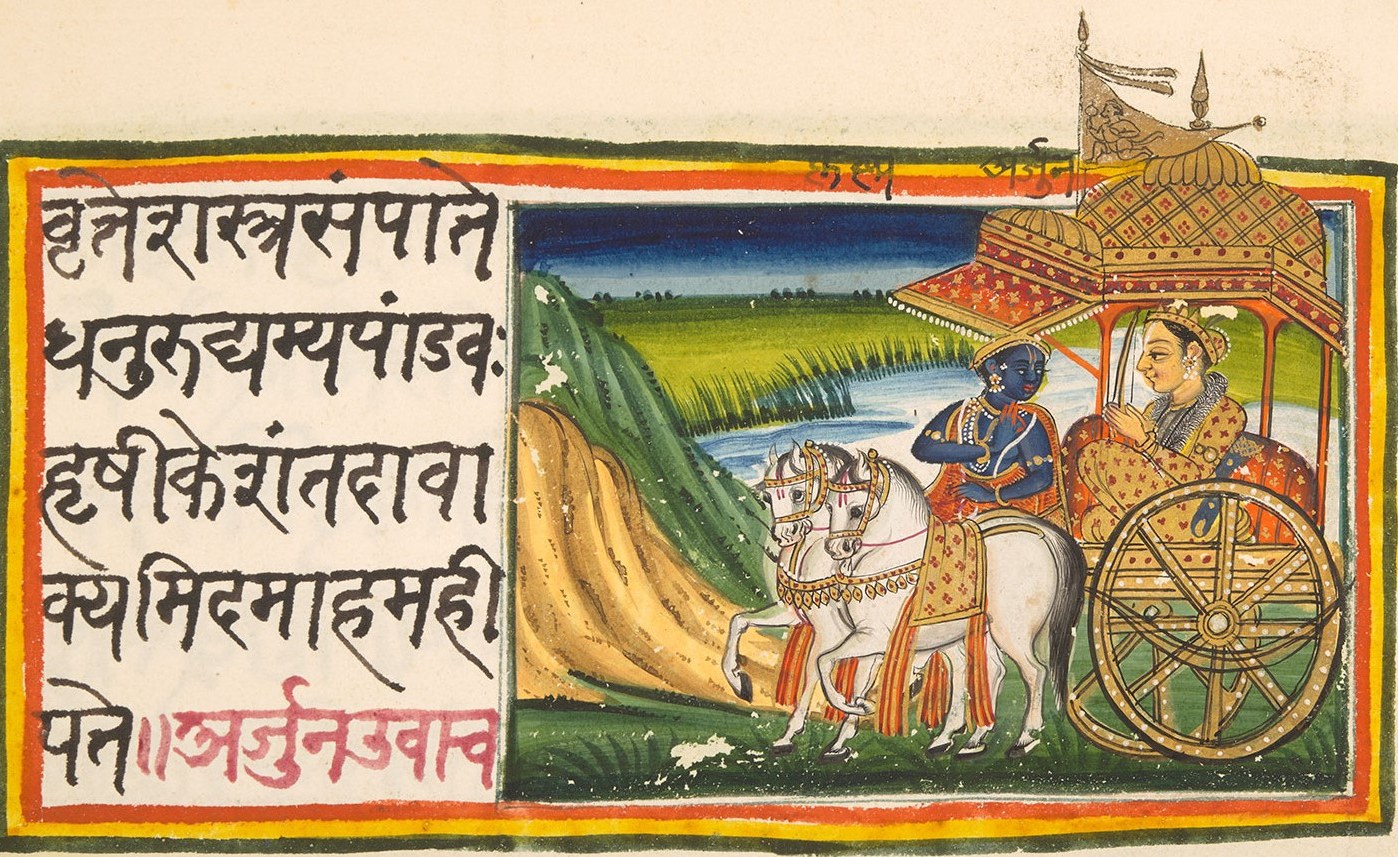
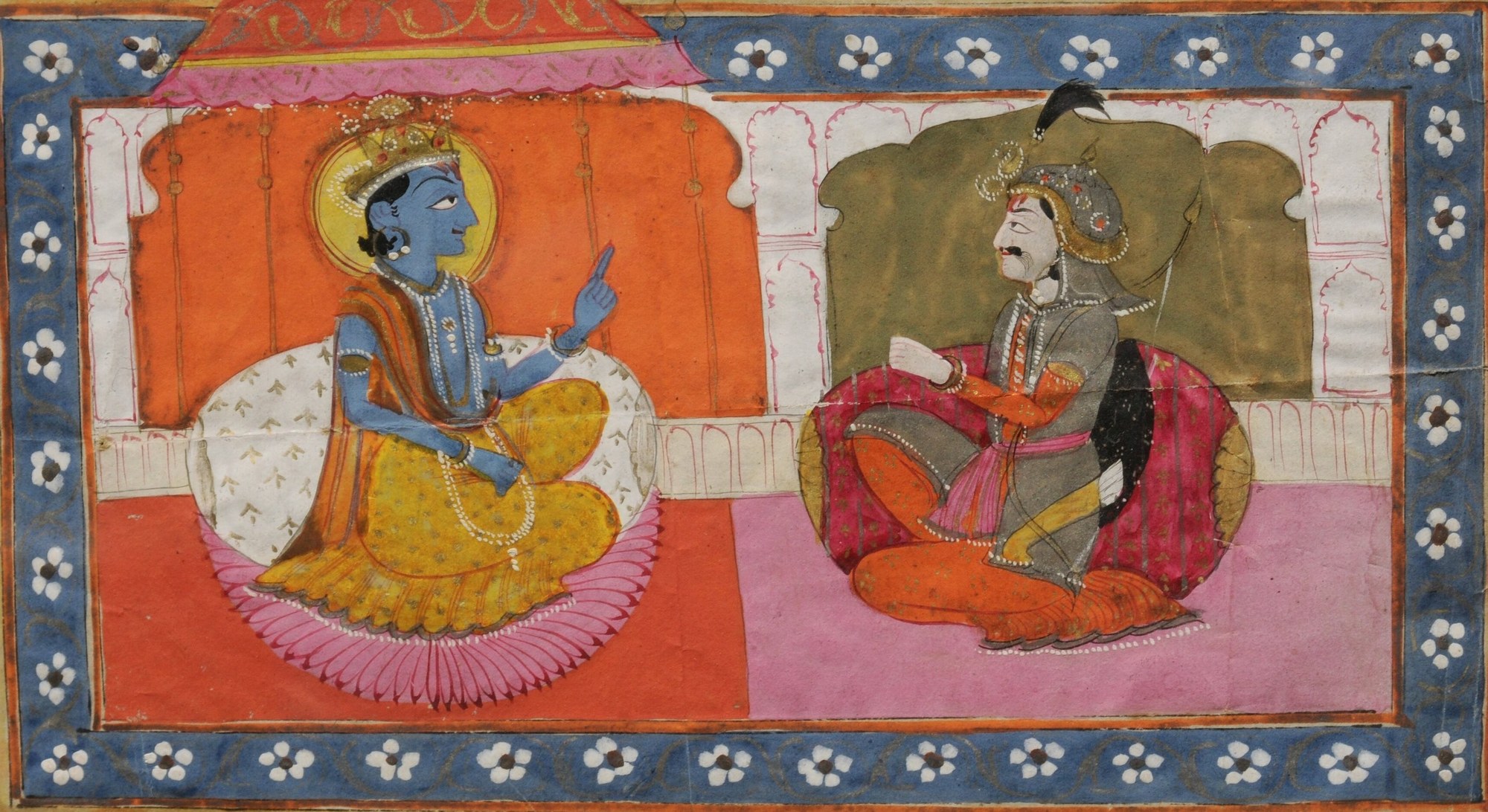
The headline verse of the whole doctrine is a warrior’s instruction on a battlefield. You have a right to perform your prescribed duties, Krishna tells Arjuna, but you are not entitled to the fruits of your actions. Never consider yourself the cause of the results of your activities, nor be attached to inaction. The command has two edges, and both cut. The first strips the actor of ownership of the outcome: the fruit was never yours to command, only the doing was. The popular compression of this line, do your duty and forget the results, softens it into advice about attitude. The verse is making a harder claim about the limits of what an actor can ever possess.
The second edge is the one most readings miss. Nor be attached to inaction. The obvious way to stop accruing karma, if deeds bind, is to stop doing deeds, to withdraw into the forest and act no more. The Gita slams that door. Non-action is not the exit. You cannot in fact stop acting, and treating renunciation of the world as the answer is only attachment wearing a hermit’s robe.
The method, stated a chapter later, is to give up the attachment and not the work: perform actions as a matter of duty, and by working without being attached to the fruits, a person attains the Supreme. The reward named is not a better rebirth further along the wheel. It is release from the wheel entirely, reached through action rather than around it.
This desireless action, nishkama-karmaDesireless action: performing one's work fully while renouncing any claim on its results, the Gita's route to acting without being bound by the act., is the most misread idea in the whole tradition, and the misreading is always in the direction of indifference. It sounds like a licence not to care, to do the job badly because the outcome does not matter. It is the reverse. The verses affirm the full right and duty to act; what they forbid is only the grasping. Desireless action is excellent action minus the clutching, the hand that does the work perfectly and does not close around the reward.
The busiest hands, the stillest heart
The Gita is honest that the whole subject is genuinely obscure. What is action and what is inaction, Krishna admits, even the wise are confused in determining this. He offers to explain the secret of action by which one is freed from bondage, and then draws a threefold distinction whose truth, he says, is profound and difficult to understand: recommended action, wrong action, and inaction, each to be understood in its nature. This is the Gita’s own three-part scheme, and it is worth flagging that it is not the later, more familiar classification of accumulated, ripening and future karma that popular accounts often read back into the poem. That system is a later development and does not appear here.
The resolution is a paradox stated as a portrait. Those who see action in inaction, and inaction in action, are truly wise among men. Although performing all kinds of actions, the free one is called the doer of all actions — in a single Sanskrit compound. This is the payoff image of the entire theme: the most active person imaginable who is nonetheless perfectly at rest — the busiest hands and the stillest centre.
The freed soul is not the one who has withdrawn from the world and folded his hands. It is the one who is doing everything, and is inwardly untouched by any of it, because the desire that would have bound each deed to him has been let go. The law that says you become what you do has not been repealed. It has simply lost its purchase on a person who wants nothing back.
You have a right to perform your prescribed duties, but you are not entitled to the fruits of your actions. Never consider yourself to be the cause of the results of your activities, nor be attached to inaction. (Bhagavad Gita 2.47, tr. Swami Mukundananda)
- Brihadaranyaka Upanishad 4.4.5 (trans. F. Max Müller, The Upanishads Part II, Sacred Books of the East vol. 15, Oxford, 1884)the oldest statement of the law here, that
as a man acts … so will he be,
a man of good acts becoming good and of bad acts bad; and the four-link chain of desire, will, deed and harvest, closing onwhatever deed he does, that he will reap.
The Brihadaranyaka is among the oldest principal Upanishads, composed c. 7th–6th century BCE; this translation is Victorian, some two and a half thousand years later. - Brihadaranyaka Upanishad 4.4.6 (Müller, SBE 15)the deed carries the actor onward through attachment,
to that he goes strenuously together with his deed,
returningagain from that world … to this world of action
; and the contrast of the man bound by desire with the desireless one who,being Brahman, goes to Brahman.
The Upanishad’s own answer to its law is the renunciation of desire, not the Gita’s later route. - Bhagavad Gita 2.47 (trans. Swami Mukundananda, holy-bhagavad-gita.org, IAST confirmed)
You have a right to perform your prescribed duties, but you are not entitled to the fruits of your actions … nor be attached to inaction.
The two-sided command: renounce the fruit, but do not flee into non-action. The Gita layer dates c. 2nd century BCE–2nd century CE, roughly four to eight hundred years after the Brihadaranyaka. - Bhagavad Gita 3.19 (Mukundananda, IAST confirmed)
giving up attachment, perform actions as a matter of duty, because by working without being attached to the fruits, one attains the Supreme.
The method of desireless action and its stated reward, release rather than a better rebirth. - Bhagavad Gita 4.16 (Mukundananda, IAST confirmed)
What is action and what is inaction? Even the wise are confused
; thesecret of action
by which one is freed from bondage. - Bhagavad Gita 4.17 (Mukundananda, IAST confirmed)the threefold distinction of recommended action, wrong action and inaction (karma, vikarma, akarma),
profound and difficult to understand.
Not to be confused with the later sanchita/prarabdha/agami classification, which is a later systematisation absent from these texts. - Bhagavad Gita 4.18 (Mukundananda, IAST confirmed)
Those who see action in inaction and inaction in action are truly wise
; the freed one, thoughperforming all kinds of actions,
is the kṛitsna-karma-kṛit, the doer of all actions. The theme’s closing image of the maximally active person who is inwardly unbound.